Real money lessons for parents
Research-backed answers to the money questions parents are actually asking — with callouts to the specific lessons your kid will play in the Sprout Saver app.

All posts

First Paycheck Explained: Gross vs Net Pay for Teens
Gross vs net pay, explained for teens: why your first paycheck is smaller than your hourly rate, what FICA and withholding take, and how much you actually keep.
Read more
How to explain crypto to teens (without the hype)
How to explain crypto to teens through a risk lens: what it actually is, why it swings so hard, the scams built for teenagers, and what to say at 13, 15, and 16.
Read more
How to explain debt to kids
How to explain debt to kids, from a borrowing story at six to good-vs-bad debt and the real cost of borrowing at sixteen, plus a Borrow-vs-Save-First tool.
Read more
How to explain opportunity cost to kids (by age)
How to explain opportunity cost to kids without a lecture: simple analogies by age, a free trade-off game, and the one moment it finally clicks.
Read more
Free allowance contract printable for kids
Allowance contract printable you can edit in the browser: set the amount, the chores, and the save-spend-give split, then download a PDF or print it in minutes.
Read more
Babysitting Rates by Age: What Should a Teen Charge?
Babysitting rates by age: what a 13, 14, 15, and 16-year-old can charge per hour, the job factors that raise the rate, and how to save what they earn.
Read more
Chores for 12-year-olds: a parent's guide.
Chores for 12 year olds, done right: which jobs a tween can really handle, what to pay, and how to turn chore money into the thing they actually want.
Read more
Chores for 8-year-olds: when paid chores begin.
Chores for 8-year-olds work best as a mostly-unpaid baseline with one or two paid extras layered on top. Here's which to pay for, and how much.
Read more
How to explain credit cards to kids
How to explain credit cards to kids, from a simple borrowing story at six to the minimum-payment trap at sixteen, plus a calculator that shows the real cost.
Read more
How to explain inflation to kids (without the jargon)
How to explain inflation to kids without the jargon: the shrinking candy bar, why prices climb, and what to actually say at nine, twelve, and fifteen.
Read more
What to do with Christmas money (by age)
What to do with Christmas money, kid by kid: a 5-minute Save / Spend / Give plan that keeps the holiday haul from vanishing in the New Year sales.
Read more
Back-to-school money skills: what your kid is ready to learn this year
Back to school money skills for kids, by age: what a 7-year-old, a 10-year-old, and a 14-year-old are each ready to practice in the first weeks of school.
Read more
Chores by Age Chart: What Kids Can Do, 6 to 16
A per-year chores chart from age 6 to 16, with family-baseline tasks, earnable above-baseline jobs, and the milestone that bends the chart, year by year.
Read more
How to Teach Kids to Budget
How to teach kids to budget at every age 6 to 16: the give-every-dollar-a-job method, the jars-to-real-income shift, and a plan that survives a surprise.
Read more
Summer Job Ideas for Teens: A Parent's Guide
Summer job ideas for teens by age: the informal gigs at 13, first formal jobs at 14 and 15, what opens up at 16, plus the work-permit rules most parents miss.
Read more
Allowance by Age Chart: How Much per Year, 6 to 16
A per-year allowance chart from age 6 to 16, with recommended amounts, save/spend/give splits, systems, and milestones for each year, and a parent's reading.
Read more
How to Get Kids to Do Chores Without Nagging
How to get kids to do chores without nagging: the four root causes of the asking-twice cycle and the structural fixes that work at every age, six through sixteen.
Read more
How Much Birthday Money to Give a Kid by Age
How much birthday money to give a kid by age, by relationship (parent, grandparent, aunt/uncle, family friend), and what the kid should do with the cash.
Read more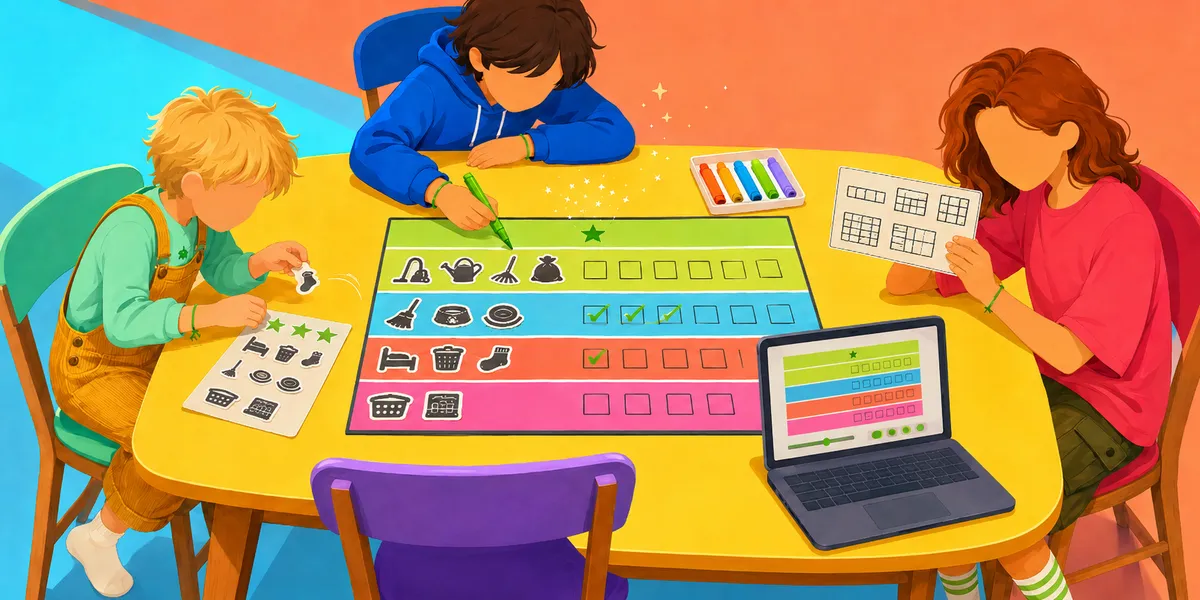
Free chore chart printable: build, customize, download
A free, fully customizable chore chart printable generator for kids. Multiple kids, age-appropriate chores, themes, real dates, PDF + PNG + print.
Read more
How to explain microtransactions to kids (and spot them in real games)
How to explain microtransactions to kids: a plain-English definition, the seven shapes they take, and a try-it-with-your-kid exercise to spot them in real games.
Read more
How to manage Roblox spending for kids (without banning the game)
How to manage Roblox spending for kids without banning the game: a monthly Robux budget, the trade-off conversation, and what to say when they want a limited-time pack.
Read more
Should kids get paid for grades? What the research actually says
Should kids get paid for grades? Probably not, and the research explains why. The four schemes parents pick from, what each one actually rewards, and the better alternative.
Read more
Should You Pay Kids for Reading?
Should you pay kids for reading? Yes, but reward the habit around reading (consistency, book-goals, milestones), not the act of reading itself. Here is how.
Read more
Summer Allowance vs School-Year Allowance
Summer allowance vs school-year allowance: keep the cash base steady, add a summer earning ramp for older kids. Predictability is the lesson, every month.
Read more
Tooth Fairy: How Much Per Tooth in 2026?
Tooth fairy: how much per tooth in 2026? The Delta Dental national average is $5.84, the first-tooth average is $7.17, plus regional variation and what to do with the cash.
Read more
How to set a V-Bucks budget for kids (without banning Fortnite)
How to set a V-Bucks budget for kids without banning Fortnite: the Battle Pass math, what each season actually costs, and what to say when the new season drops.
Read more
Chores for 16-year-olds: from chore chart to real work
Which chores a 16-year-old should be doing, why the dollar-per-chore model breaks at this age, and how to transition the chore chart into real work.
Read more
Chores for 6-year-olds: what they can actually do
Chores for 6-year-olds, with a parent's playbook for each: what to skip, what to try this month, and why we don't pay for them yet at this age.
Read more
How to explain compound interest to kids (without the math)
How to explain compound interest to kids without a whiteboard: the snowball, the jar that grows on its own, and what to actually say at the kitchen table.
Read more
How to teach kids to save money: five moves that work
How to teach kids to save money with five parent moves that work at six, ten, and fifteen: name the goal, make it visible, match the first dollar, set a default rate, celebrate.
Read more
My Kid Wants Everything at the Store. What Do I Say?
My kid wants everything at the store. Five aisle scenarios, the script ladder that de-escalates each one, and what to say when the first script doesn't land.
Read more
Save, Spend, Give: the simple money system for kids
Save, Spend, Give jars for kids: the percentage split that works, why the Give jar matters most, and a drag-to-rebalance tool to set yours.
Read more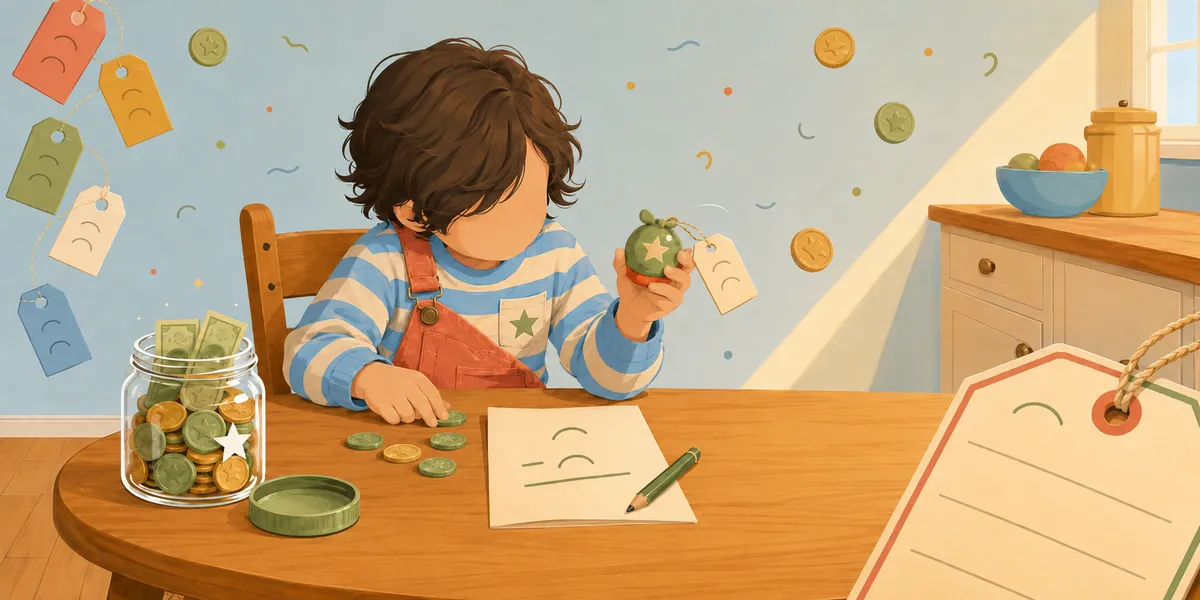
Teaching a 7-year-old about money: the price-tag year
Teaching a 7 year old about money: the price-tag year, when reading the price, doing the subtraction, and making the call all start working at the same time.
Read more
Teaching delayed gratification without sounding like a lecture
How to teach delayed gratification to kids without lecturing. The Vault trick, the 24-hour rule, and what the marshmallow research actually says.
Read more
Allowance app vs kids debit card: what comes first?
Allowance app vs kids debit card: which should come first? Five readiness signals that tell you when your kid graduates from virtual to real money, with the parent's playbook.
Read more
Chores for 10-year-olds: a practical parent guide.
Which chores a 10-year-old can really handle, what to pay for which task, and how to set up a chore contract that sticks, without the nagging.
Read more
Family Money Night: A weekly routine for money habits
A weekly money routine for kids that takes 25 minutes. The four stations of Family Money Night, age-by-age scripts, and a printable agenda card.
Read more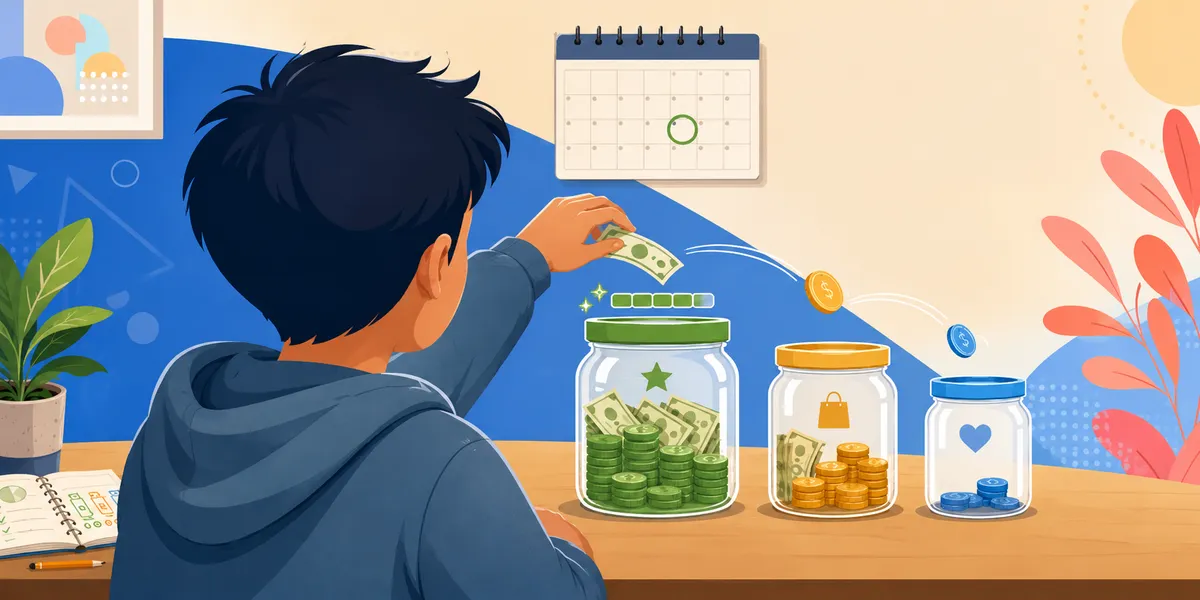
How much allowance for a 10-year-old? A parent's guide.
Research-backed amounts, frequency, and the save / spend / give split that turns weekly allowance into real money habits, before a debit card.
Read more
How much allowance for an 11-year-old? Needs, wants, and peer pressure.
What to pay an 11-year-old, how peer comparison shifts spending, and the conversations that help them distinguish needs from wants before middle school.
Read more
How much allowance for a 12-year-old? Identity money has arrived.
How twelve-year-olds spend differently, how to set an allowance that respects their growing identity, and what the right save rate is before the teen years.
Read more
How much allowance for a 13-year-old? The chore-to-real-work pivot.
What 13-year-olds need from allowance, when to introduce real income, and how to use the pre-debit-card year to lock in the habits that survive teens.
Read more
How much allowance for a 14-year-old? Real goals, real saving.
Setting allowance for a fourteen-year-old when real goals appear (instruments, summer trips, gaming setups), and how to bump the save rate without a fight.
Read more
How much allowance for a 15-year-old? Allowance meets a real paycheck.
What to pay a 15-year-old as a real job becomes possible: paystub literacy, taxes, and how to keep allowance useful when earnings dwarf it.
Read more
How much allowance for a 16-year-old? Cars, insurance, and the budget supplement.
What sixteen-year-olds need from allowance once a driver's license and a real paycheck are in the picture, and how to phase the household budget over.
Read more
How much allowance for a 6-year-old? Starting before they can multiply.
First allowance amounts, why cash and jars beat apps at six, and how to set up save / spend / give before your kid can read a price tag.
Read more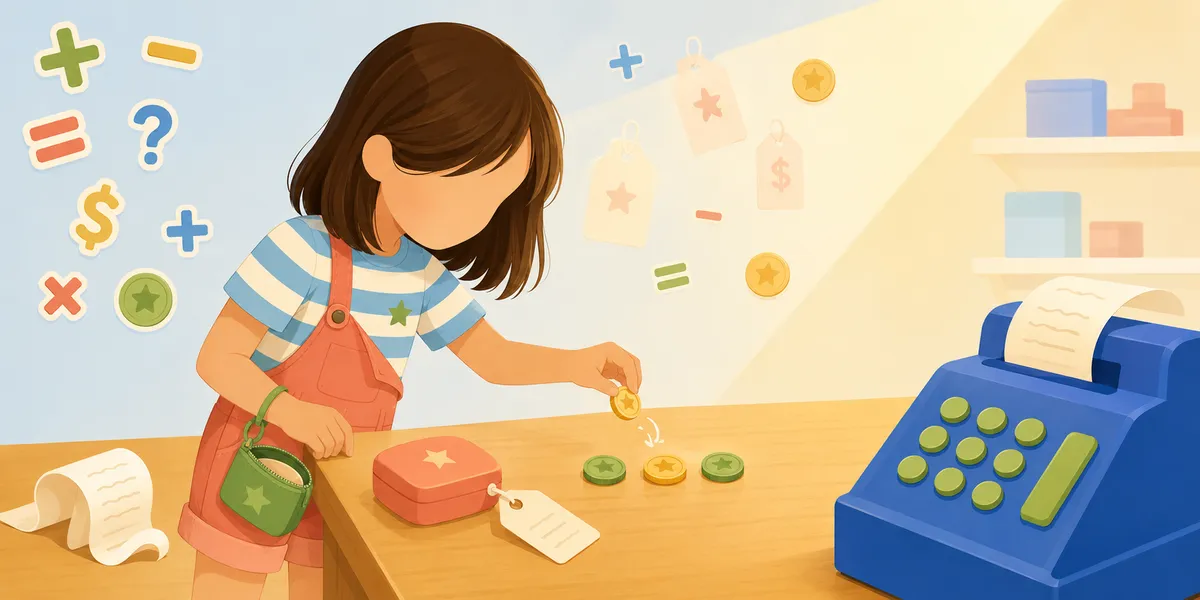
How much allowance for a 7-year-old? Reading the price tag year.
What seven-year-olds can handle: reading prices, counting change, and using allowance as a literacy tool before it becomes a budgeting tool.
Read more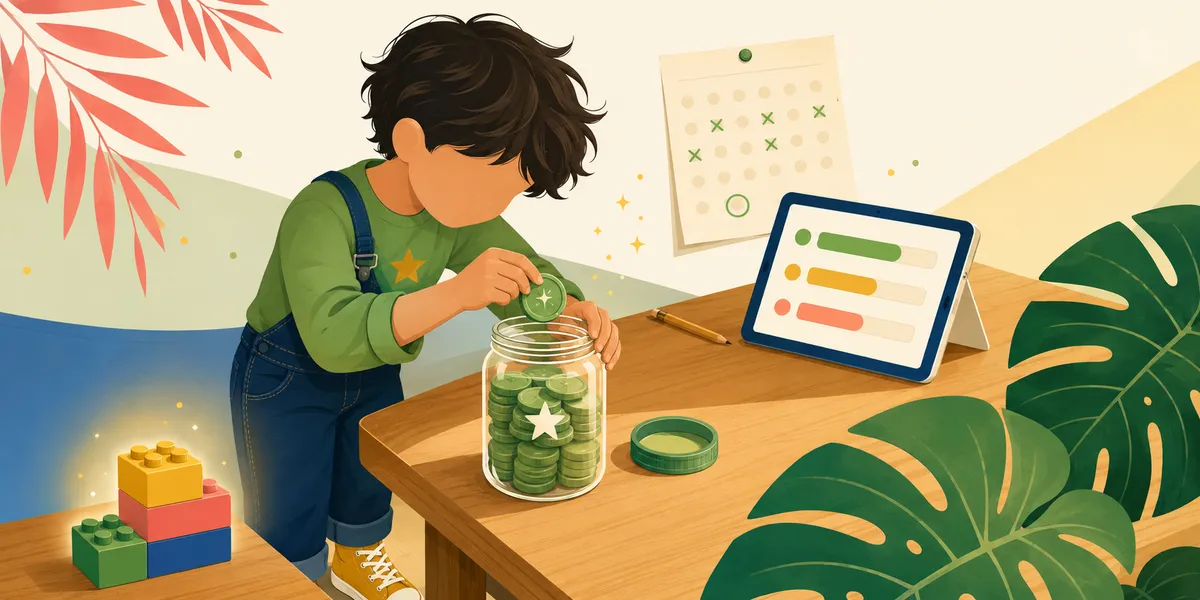
How much allowance for an 8-year-old? The first real savings goal.
Why eight is the right age for a first real saving goal, when to move from cash jars to a virtual system, and how to set up a hybrid allowance.
Read more
How much allowance for a 9-year-old? Letting them blow it once.
Why nine is the right year for the first real spending consequence, how to set save / spend / give for a preteen, and what to do after a blowout.
Read more
How to Talk to Kids About Money Without Making It Awkward
How to talk to kids about money without it feeling weird. Research-backed scripts for the awkward questions (Are we rich? How much do you make?) at every age.
Read more
Is my child ready for a debit card? A parent's checklist.
Is my child ready for a debit card? A twelve-item readiness check across money skills, self-control, and what you've set up at home, plus the lessons that close each gap.
Read more
My kid spends money too fast. What should I do?
Kid spends money too fast? The four profiles behind fast-spending kids, the one Sprout Saver tool that fits each, and a parent's calm-recovery playbook.
Read more
Needs vs wants activities for kids: a parent's playbook
Needs vs wants activities for kids: seven you can run this week, the trap most worksheets fall into, and the script that lands at the candy aisle.
Read more
Should kids get paid for chores? The pros, cons, and a better system.
Unconditional allowance, paid chores, or hybrid. What the research says about each, where each one breaks, and why most parenting experts land on the third option.
Read more
Teaching a 6-year-old about money: what actually sticks
Teaching a 6-year-old about money: the four habits that actually stick (coins, jars, waiting, and needs vs wants), with a parent's playbook for each.
Read moreGet the next guide in your inbox
One short, research-backed parenting-money guide every other Sunday. Free, no spam, unsubscribe anytime.
See the system in action
The lessons we reference in these posts live inside Sprout Saver. Try the demo to see what your kid will play, with no signup required.