In this guide
★ Key takeaways
- An allowance app comes first. A kids debit card comes when the readiness signals are there, not when the birthday is.
- Five signals tell you when to graduate from virtual to real: a saved-toward goal, cash responsibility, unsupervised purchases, six months of money tenure, and a handful of finished spending lessons.
- Most kids land in the training-wheels zone (3 or 4 signals) somewhere between 9 and 12. That is the sweet spot for a parent-piloted card with the app still doing the saving brain-work.
- Skipping the app step is the most common parent mistake. A debit card without a savings habit is just a faster wallet.
- When you do hand over the card, keep the allowance app for goals, giving, and the weekly rhythm. The two tools layer; they do not replace each other.

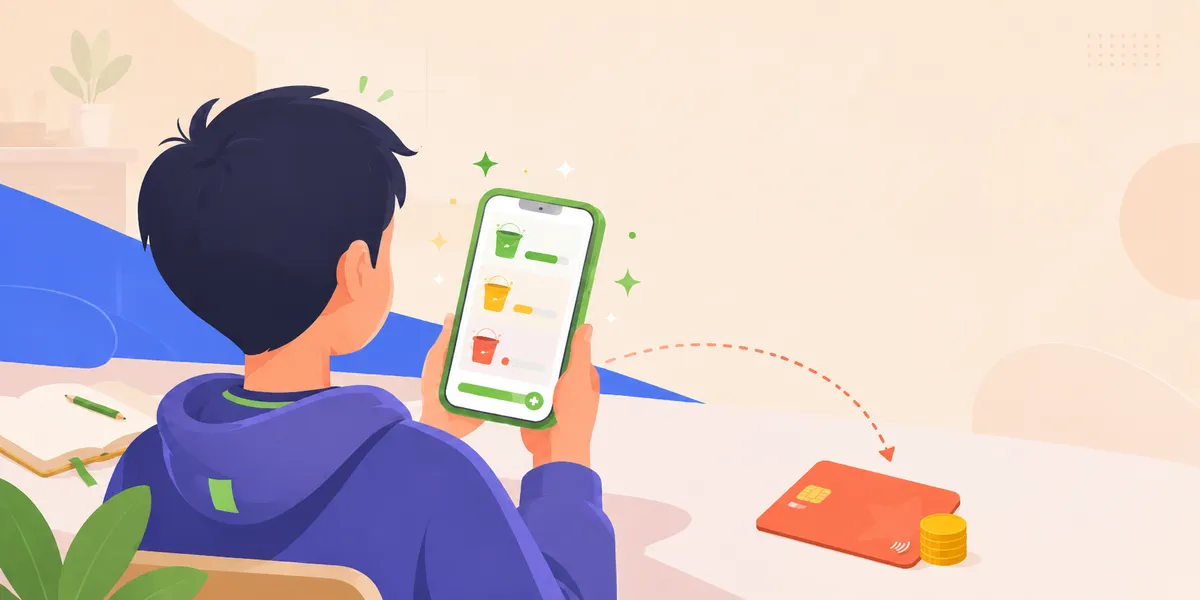
Allowance app vs kids debit card: what should come first? Almost every parent of a 9-to-14-year-old hits this fork. The marketing pitches both tools as the right answer, often the same week your kid asks for a card because three friends just got one. Sequencing is what wins here, not picking a side. An allowance app is the brain of money: virtual buckets, goals, lessons, a record of every dollar. A kids debit card is the friction of money: real purchases, real consequences, a real plastic rectangle that can vanish at recess. The CFPB's Building Blocks model is clear that financial habits form earlier than financial autonomy. The order matters. The app builds the habit. The card is what the habit gets practiced on.
The short answer: app first, card when they're ready
For most families, the right sequence is virtual first, real second. Use the pillar guide on teaching kids about money by age as the backdrop and the five signals below as the meter. When three or four of these are true, you are in the training-wheels zone (card with parent controls, app still running the planning side). When all five are true, your kid is ready for a real debit card without training wheels.
- They have saved toward a goal for four-plus weeks. Sustained saving, not a one-week novelty.
- They can hold $20 cash for a week without losing it. Physical responsibility is a fair proxy for card responsibility.
- They regularly make purchases without you present. School cafeteria, vending machine, friend's birthday, the run for milk.
- They have earned and managed their own money for six-plus months. Tenure of experience beats age every time.
- They have finished at least five spending-themed lessons in an app or walked through with you at the kitchen table.
What to check
Each one is independent. Three or four is normal.
When most kids start
But age is the worst predictor. Behavior is the best.
Score your kid against the five signals below. The result lands them in one of three zones (not yet, training-wheels, or ready for a real card) and surfaces the single dominant gap to work on next.
★ Interactive · 60 seconds
Is your kid ready for a debit card?
Most 9-year-olds clear one or two of these. Most 11-year-olds clear three. Most 13-year-olds clear four. The numbers move with the kid, not the calendar. If you want the long-form, teen-specific version of this check (12 criteria across money skills, behavior, and household logistics), the is-my-child-ready-for-a-debit-card deep dive is the next stop after this one.
What each tool actually teaches
The two tools are not redundant. They teach different things, and they teach them in a different order.
An allowance app
Teaches the brain of money. Save / Spend / Give buckets, recurring deposits, goals with progress bars, a Vault that locks money down on purpose, lessons that explain what a balance even is.
A kids debit card
Teaches the friction of money. Real purchase decisions, tax and tip, the wait for a pending charge to clear, the small panic of a misplaced card. Real because the dollars are real.
An allowance app is where your kid learns the concepts. Save / Spend / Give buckets put the percentages on screen instead of in your head. A goal with a progress bar makes a $40 saving target visible in a way a number written on a sticky note never quite manages. A vault that locks the money down for ten days teaches that some money is for later, on purpose. The lessons in the app explain what a balance is, why pending charges hang there for a day, and what a refund window means. The friction is low because the dollars are virtual; that low friction is exactly what makes early practice safe.
A kids debit card is where your kid learns the consequences. The Greenlight, GoHenry, and BusyKid category sells itself as "teaching financial literacy," and to some degree it does, but the product itself is a payment rail. The teaching is whatever framework you wrap around it. The card is real friction, and that real friction is the point: tax adds money to the price tag, shipping adds more, a $14 game is actually $16.27 at checkout, and a card left in a movie theater is gone in a way a virtual balance never is. Those lessons cost money to learn. They are cheaper to learn at 10 (with parent limits) than at 16 (without).
The order is virtual-then-real for the same reason kids ride a balance bike before a pedal bike. You learn balance first, in a low-friction setting, then you add the pedals.
Why sequencing matters more than timing
A regretted $10 purchase at nine teaches the same lesson as a regretted $200 purchase at fifteen. The cheaper one teaches it without scarring. That is the whole sequencing argument.
A regretted $10 purchase at nine teaches the same lesson as a regretted $200 purchase at fifteen. The cheaper one teaches it without scarring.
The CFPB's Money As You Grow milestones place "uses a debit card" in the 13-to-18 band, but the same document places "saves money for short-term goals" and "compares the cost of things before buying" several years earlier. A kid who skips the cheap version of those mistakes does not get a discount on them; they just learn them later, with bigger dollar amounts attached. The OECD's PISA 2022 financial literacy results reinforce the same pattern across countries: 15-year-olds who report household practice with money (chores, allowance, saving toward goals) outperform those who do not, by margins that hold up after controlling for income and parent education. Practice is the variable. The tool you practice on is just the venue.
Delayed gratification is the underlying skill, and it is fragile. Allowance apps build it in the easiest way possible: with a visible savings progress bar that goes up over time. Sprout Saver's Vault feature takes it a step further by locking the money down for a chosen number of days and paying out bonus Saver Stars when the timer ends. That is rehearsal. The card is the performance.
Lessons that build the readiness
The signals are not abstract. Each one maps to a specific habit your kid can practice, and most of those habits are exactly what the spending-and-banking lesson tracks in Sprout Saver are designed to build. Three to start with:
That sequence walks the arc the post is making. The $10 challenge teaches opportunity cost without a card in the picture. The Debit Card Deep Dive demystifies what the card actually is before it shows up in your kid's wallet. Available vs current balance is the lesson the first month of card ownership is going to make them learn the hard way; better to learn it first.
When to make the switch, and how to do it gracefully
When the readiness meter lands in the training-wheels zone (three or four signals true), do not flip a switch. Layer instead.
Start with a parent-co-piloted card. That means low limits, merchant categories you block on purpose (gambling, in-app purchases, anything you want to handle the conversation about), instant alerts on every transaction, and an explicit weekly review. The card is on training wheels for thirty days; the goal of those thirty days is not to "let them learn by failing," it is to have small, recoverable conversations after every transaction.
Keep the allowance app running underneath. The card becomes the spending arm. The app stays the planning brain: the place the weekly allowance lands, the place the savings goals live, the place the Give jar empties from. Two tools, two jobs. A kid who blows $40 on Roblox at eleven has a cheaper version of the same lesson as a sixteen-year-old who blows $400 on Steam. The thirteen-year-old whose Vault releases the $60 they saved toward a new pair of headphones is rehearsing the same delayed-gratification reflex that the eighteen-year-old will need for a security deposit.
After thirty days, loosen one limit. After ninety, loosen another. Treat the card the same way you treated a kitchen knife: supervised first, then partial autonomy with clear rules, then full autonomy. The allowance amount itself does not need to change much in this transition; what changes is where the money lives and who is watching it land.