Save
Money earmarked for future goals and long-term growth. Children learn that some dollars are for later, not for right now.
We use cookies and analytics to improve your experience. Analytics are never used on child-facing pages. Learn more
Sprout Saver gives your child a visual, guided money system where every dollar has a job. They earn, sort, save, spend, give, and learn inside an experience that builds judgment through daily practice, not lectures.
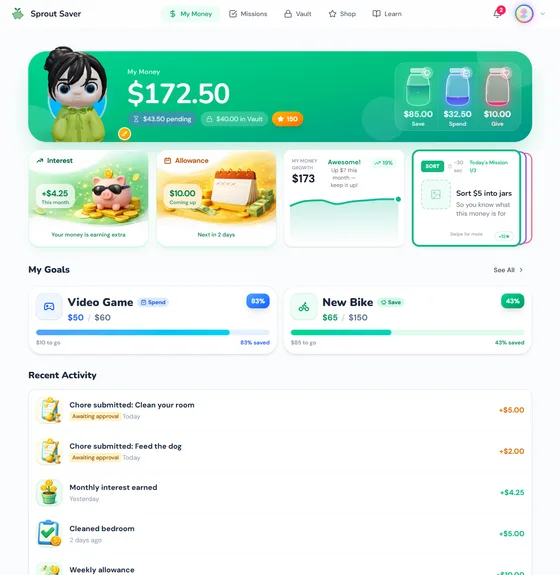
Inside the child experience
Animated jar balances
Active savings goals
Daily mission prompts
Avatar and rewards
Before children learn sophisticated financial products, they need to learn that money has different jobs. The jar system turns every dollar into a visible choice: save it for later, use it now, or share it with others.
Money earmarked for future goals and long-term growth. Children learn that some dollars are for later, not for right now.
Money available for everyday wants and short-term choices. Kids practice deciding what is worth it and what can wait.
Money set aside for charity, gifts, and intentional generosity. Giving is treated as a core part of a healthy money identity.
Animated balances
Children see their money move in real time with animated jar displays and per-jar transaction history.
Sorting practice
When new money arrives, an unallocated balance prompts your child to decide where it goes.
Default splits
Parents set ratio defaults so income can auto-route, or children can practice the split each time.
Transfer freedom
Kids can move money between jars at any time, encouraging active decision-making and ownership.
Sprout Saver is strongest when the whole system works as a loop. Your child does not need to hit every step each day, but over time, money becomes a system of choices instead of a series of isolated wants.
Allowance arrives on schedule. Chores get completed and approved. Money enters the system with a clear source so your child connects income to effort or routine.
New money lands as unallocated, prompting your child to decide how much goes to Save, Spend, and Give. Purpose comes before use.
Money moves toward a named goal or into a vault. Your child ties present restraint to a visible future outcome.
When your child wants to spend, redeem a goal, or donate, they submit a request. You review it with full context and approve or discuss.
Lessons, missions, and games reinforce the same behaviors with guidance, scenarios, and examples that connect to the money your child is already managing.
Progress bars, streaks, badges, and history make choices visible. Your child can see what worked, what changed, and what to do next.
Why this loop matters
The CFPB frames youth financial capability as an interaction among executive function, financial habits, and knowledge. This loop maps to all three: sorting and planning build habits, goals and vaults strengthen executive function, and lessons reinforce knowledge inside the same system where money decisions happen.
Goals, vaults, allowance, chores, cashouts, and growth rewards work together so your child builds planning, patience, and accountability through repeated use.
Children create named goals with a target amount, optional deadline, and a custom icon. Progress bars show how close they are, and auto-allocation can route income toward a goal automatically.
Vaults let your child lock money away for a set time or until a goal is reached. Early release requires a reason and your approval, turning impulse moments into guided conversations.
Automated recurring allowance gives your child a reliable payday. They learn to plan around a known cadence instead of reacting to random cash.
Children see available chores, complete them with optional photo proof, and submit for your review. Approved earnings flow into the same jars and goals as allowance.
When your child is ready to spend or redeem a goal, the request moves through approval, fulfillment, and tracking. Both sides know what was promised and what was delivered.
Parent-controlled monthly rewards help children experience a simple pattern: money that stays protected increases over time. Rewards always deposit into Save, reinforcing the saving habit.
Gamification works best when it points toward the behavior you want. Saver Stars, missions, badges, and avatar rewards are all earned through saving, learning, and consistency, never through real-money purchases or reckless spending.
Personalized next-step prompts like sorting new money, completing a chore, or finishing a goal step keep your child coming back with clear purpose instead of aimless browsing.
A virtual currency earned through saving, learning, and consistency. Stars unlock avatar cosmetics and are never purchased with real money, so the reward loop always points toward positive behavior.
Over 30 badges celebrate milestones across saving, learning, earning, and consistency. Streaks reward regular practice with escalating bonuses at 7, 14, and 30 days.
A fully customizable 3D character with 844+ cosmetic items across 10 categories. Every item is earned through good financial behavior. Self-expression keeps the 8–13 range engaged week after week.
The reward loop in practice
Your child saves money and earns Saver Stars. Stars unlock avatar cosmetics in the shop. The desire to unlock new items drives more saving, learning, and consistency. The result is a positive cycle where engagement and good financial behavior reinforce each other.
A six-year-old needs a different experience than a fourteen-year-old. The same core system adapts in complexity, lesson depth, and autonomy as your child matures.
Start with habits your child can actually see.
Build judgment before a debit card becomes the default.
Prepare for real-world financial independence.
“Is this just a digital piggy bank?”
It starts with the same idea, but goes much further. Jars, goals, vaults, chores, missions, and lessons work together as a system that builds real money habits through daily practice.
“Will my child actually use this regularly?”
Daily missions, streaks, badges, and avatar rewards give children a reason to return. The engagement is tied to positive financial behavior, not endless scrolling.
“Is the money in the app real?”
Yes. Balances represent real money commitments between you and your child. When your child reaches a goal or requests a cashout, you fulfill it in the real world and the app tracks it.
“Can my child spend without my permission?”
No. Withdrawals, goal redemptions, and donations all move through a parent-approval workflow. You stay in control of real-world payouts.
“Are the avatar purchases made with real money?”
Never. Avatar cosmetics are purchased with Saver Stars, which are earned through saving, learning, and consistency. There are no real-money purchases in the child experience.
What children experience over time
Jars, goals, vaults, missions, and earned rewards work together so your child practices judgment every day, not just when money comes up.