Lectures Alone
Easy to forget by tomorrow
One-off talks about money often fade quickly because there is no system for children to apply what they heard.
We use cookies and analytics to improve your experience. Analytics are never used on child-facing pages. Learn more
Over 202 lessons across 6 interactive formats, organized by age and guided by companion characters who coach different money mindsets. Learning happens inside the same app where your child earns, saves, and makes real choices.

Instructor-led lessons introduce key ideas quickly so kids can apply them in activities right away.
Great for introducing a concept before practice.
Most children forget financial concepts taught in isolation. Sprout Saver's learning lives inside the same system where kids earn allowance, save toward goals, and make spending decisions, so lessons reinforce the habits they are already practicing.
Lectures Alone
One-off talks about money often fade quickly because there is no system for children to apply what they heard.
Standalone Education Apps
Learning apps can teach concepts well but often live far from the place where kids actually manage money.
Sprout Saver Learning
Lessons and real money tools live in the same app, so children apply new ideas to their own jars, goals, and decisions immediately.
Children at six need different concepts than teenagers at fourteen. Every lesson is organized by developmental stage and grounded in research on how children actually build financial capability.
Ages 6–8
72 lessonsStart with habits that stick for life
At this age, children are forming the core attitudes and routines they will carry into adulthood. Sprout Saver Foundations uses visual, story-driven lessons to build a child’s first framework for understanding what money is, where it comes from, and why some of it should be saved, shared, and planned for.
What the research says
Cambridge University researchers found that core money habits are largely formed by age seven. Their review of over 100 studies spanning 30 years concluded that the attitudes and routines children develop in early childhood shape financial decisions throughout life.
Whitebread & Bingham, Cambridge University / Money Advice Service, 2013
Developmental insight
The CFPB’s Building Blocks model identifies executive function—the ability to plan, focus, and practice self-control—as one of three pillars of financial capability. In this age range, children are actively developing these skills through structured routines and simple decision-making practice.
CFPB Building Blocks Model · Executive Function Research
Curriculum topics · 8 areas
Children learn what money is, how coins and bills represent value, and how prices, receipts, and change work in everyday life. These foundational concepts help kids see money as something real and countable before they encounter it digitally.
Lessons connect work to income through chores, helping around the house, and early job concepts like running a lemonade stand. Children begin to understand that money comes from contribution, not just from asking.
Children set their first savings targets and learn the difference between keeping money at home and using a bank. Lessons cover emergency funds, the concept of saving for something specific, and how progress toward a goal feels rewarding over time.
Needs vs. wants is the central concept here. Children practice spotting advertising tricks, recognizing in-app purchase pressure, understanding returns and refunds, and making thoughtful purchase decisions instead of impulsive ones.
Using Save, Spend, and Give jars, children learn that dollars have jobs. Lessons walk through sorting money by purpose, planning a small event, and managing a fundraiser so the concept of allocation becomes intuitive before formal budgeting.
Generosity is treated as a core part of financial identity, not an afterthought. Children explore different ways to give, learn how to evaluate where their contributions go, and practice making giving decisions with intention.
Children explore the emotions tied to wanting, waiting, and choosing. Lessons build emotional self-regulation through cooling-off exercises, values identification, and recognizing the difference between excitement and genuine need.
An age-appropriate introduction to how banks work, what ATMs and debit cards do, and what happens when money is lost. These lessons reduce fear and confusion around banking by making the system simple and approachable.
What your child can do after this stage
Companion guidance
Companions at this stage keep lessons warm and playful, helping young children feel safe exploring money for the first time.
Some children learn through stories, others through games, and others by watching. Sprout Saver uses 6 formats so every child finds a way in.
Short videos that make concepts click
Instructor-led lessons introduce key ideas quickly so kids can apply them in activities right away.
Great for introducing a concept before practice.
Stories that connect money to real feelings
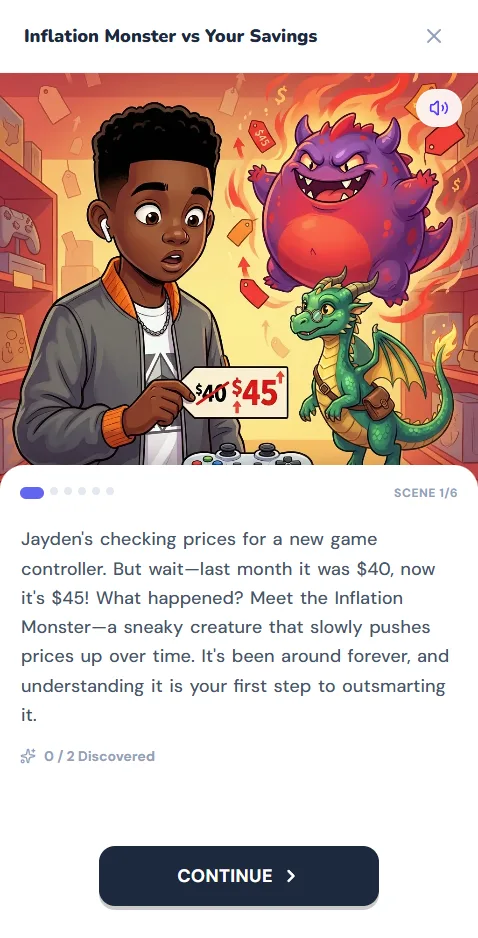
Narrative lessons help children connect decisions to emotions, values, and consequences.
Turns abstract ideas into relatable moments.
Branching choices that build judgment
Kids make a choice, see what happens, and improve next time in a safe environment.
Builds better decisions through repetition.

Social-pressure scenarios in chat format
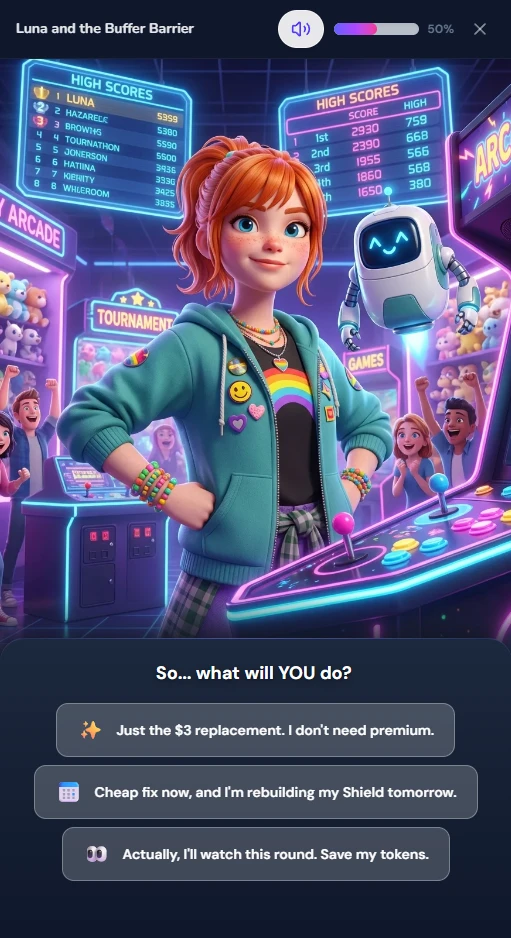
Learners practice handling peer pressure, FOMO, and online persuasion in realistic chat threads.
Teaches boundaries in social money moments.

Games where every choice has a trade-off
Game worlds and simulations reinforce planning, risk awareness, and patience under pressure.
High engagement with real-life skill transfer.
Our team ships fresh lessons, games, and simulations weekly so your child always has something new to explore.
Always growingFrom first money basics to credit, investing, and scam awareness, lessons expand naturally as your child grows. Every topic is available when your family is ready for it.
Ages 6–12
Learn the fundamentals of money
Ages 6–16
Ways to earn and grow your income
Ages 6–16
Building your savings
Ages 6–16
Make smart purchase decisions
Ages 6–16
Plan and track your money
Ages 13–16
Grow your money over time
Ages 6–16
Share with others
Ages 6–16
Bank accounts and services
Ages 13–16
Understanding credit
Ages 13–16
Plan for your future
Ages 6–16
Understanding emotions and money
Ages 13–16
Spot scams and protect your money
Each age group has its own companion crew. Every character coaches a different money mindset, so your child builds well-rounded financial judgment.
Sprout Saver is not a classroom and a wallet in two different places. Learning and money management share the same environment, so your child practices what they learn immediately.
After learning about needs vs. wants, kids sort their own money into Save, Spend, and Give jars using the same principles.
Lessons on budgeting and goal-setting connect directly to the goals your child is already tracking in the app.
When a lesson covers delayed gratification, your child can immediately lock money in a vault to practice it.
Daily missions connect lesson content to real money actions so learning turns into repeatable habits.
Each companion reinforces a different money mindset, helping your child approach decisions from multiple angles.
Stars, badges, and streaks reward consistent learning so your child stays motivated week after week.
Children earn Saver Stars for completing lessons, finishing goals, and staying consistent. Stars unlock avatar cosmetics and badges, not real-money purchases, so rewards stay connected to positive behavior.
Personalized next-step suggestions, like sorting new money, finishing a goal step, or completing a lesson, keep children coming back with purpose.
Consistency matters more than intensity. Streaks reward regular practice, and 30+ badges celebrate milestones across saving, learning, and earning.
Self-expression keeps the 8-13 age range engaged. Children customize their avatar with cosmetics earned through positive behavior, not real-money purchases.
"Is this just another screen-time app?"
Lessons are short, purposeful, and connected to real decisions your child is already making inside the app. The goal is better judgment, not more scrolling.
"My child is only 7. Is this too advanced?"
Lessons start with simple, visual concepts like needs vs. wants and first savings goals. Younger children get age-appropriate content that builds confidence through small wins.
"Will my teenager find this engaging?"
Older kids get chat simulations about peer pressure, decision stories around real spending traps, and game-based scenarios that feel relevant to their world.
"How is this different from a money textbook?"
Lessons live inside the same app where your child earns, saves, spends, and sets goals. Learning and practice happen in the same place, so concepts stick.
"Do I need to teach alongside the app?"
You do not need to run the lessons. But the app creates natural conversation starters: requests, goals, trade-offs, and companion prompts that make money talks easier.
What parents notice over time
Over 202 lessons, 6 interactive formats, and 14 companion characters are ready to help your family build stronger money habits together.