
★ For parents of teens

How much allowance for a 16-year-old? Cars, insurance, and the budget supplement.

What sixteen-year-olds need from allowance once a driver's license and a real paycheck are in the picture, and how to phase the household budget over.

Sprout Saver Team · 8 min read
A faceless 16-year-old in a denim jacket and crossbody bag with car keys, standing on the front porch holding a piece of mail, with envelopes (phone, water drop, fuel pump, house icons) tumbling out of a red mailbox beside them. A blue car at a charging station and a city skyline with a school building in the background, sunset palette. The bill-handover moment.
In this guide

★ Key takeaways

  • Allowance becomes a supplement. Most income should come from work.
  • Sixteen is the year real recurring bills enter their life: phone, gas, insurance.
  • Save rate stays at 60%, including a Roth contribution if there's earned income.
  • Two years before they leave home. Make sure the habits are real, not performative.
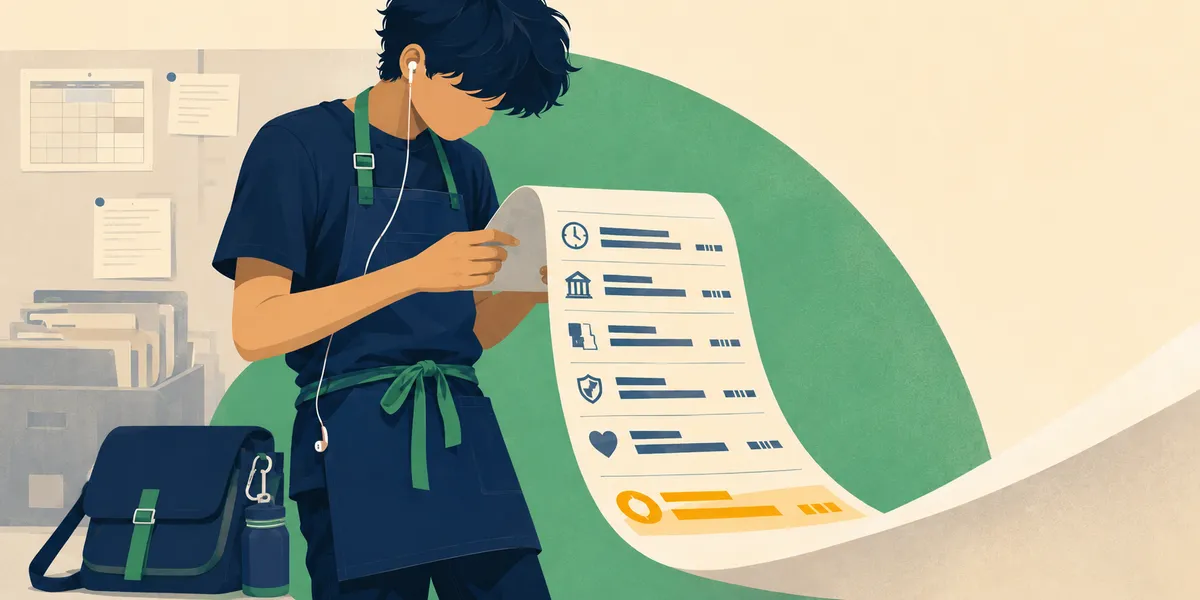
Sixteen is the year almost every variable changes at once. The driver's license arrives, often with a car or shared car access. The part-time job is now possible at most hours, in most industries, with real W-2 income and real recurring expenses. The cell phone bill (for a teen the family used to absorb) starts shifting to them. Gas is now a real category. Car insurance hovers as a multi-hundred-dollar concept. And underneath all of it, college is exactly two years out, and the question of who pays for what is no longer hypothetical.

In this context, allowance (as a structural concept) is mostly done. Sixteen is the year it transitions into a supplement, then for most families, into nothing. The habits you spent ten years building from cash-and-jars to virtual accounts to debit cards now meet real income, real bills, and real autonomy. The job of this year is to make sure those habits hold under that load.

The CFPB's Building Blocks model places ages 16–21 in the "decision-making with real consequences" stage. The Money As You Grow milestones for older teens (paychecks, taxes, credit basics, opening adult accounts) all live in this window. Sixteen is the first year of it, and the habits you reinforce now are the ones that show up at twenty-six.

The short answer: allowance ends, earnings begin

Two reasonable starting points for a sixteen-year-old:

$0–$10/week

Symbolic base

Many families drop allowance entirely at sixteen. Both are defensible.

$80–$250/week

Real earned income

Part-time job + side work. The dominant money story at this age.

For most families, the allowance era ends here, either dropped entirely or scaled down to a symbolic $5–$10/week. The reason isn't punitive; it's structural. A teen who is working 15–25 hours a week at $14/hour is taking home roughly $700–$1,200 a month after withholding. Continuing to layer allowance on top of that adds nothing to the financial education and, occasionally, blunts the message that earning is now the primary money story.

The honest framing for your kid: "The job of allowance was to teach you the structure. You've learned it. Real money now comes from real work." Said once, calmly, with a clear date for the change.

By sixteen, the only useful question about allowance is whether you still need to be paying it at all.

The bill-handoff schedule

The single most useful exercise of the year is phasing recurring household expenses onto the teen's budget, one at a time. Trying to do all of them at once collapses the lesson under its own weight; doing them sequentially makes each one a real budget item.

A reasonable order:

  1. Phone plan ($20–$40/month, depending on family setup). Easy to compute, completely visible, impossible to ignore. Most useful first handoff.
  2. Gas for personal driving (variable, $40–$120/month depending on habits). Teaches trip-planning, ride-sharing, and consolidation behaviors.
  3. Car-insurance sinking fund ($30–$80/month to a separate save category). Builds the muscle of paying-toward-an-upcoming-irregular-cost.
  4. Some discretionary categories (streaming subscriptions, clothing above basics, takeout). Each one transferred explicitly, with a stated month-of-handoff.

The transferred items should appear as recurring categories in the teen's budget. Sprout Saver's youngteen lessons specifically introduce category-based budgeting for this reason. The OECD's PISA 2022 results found a strong correlation between teen experience with recurring bills and adult financial outcomes. The amount paid is incidental; the experience of seeing the same line item charge again next month is the lesson.

The split for a sixteen-year-old's paycheck

For earned income at this age:

  • Save 60%: including any Roth contribution + 529 supplement + car-insurance sinking fund + general savings
  • Spend 25%: for in-the-moment spending, day-to-day, social
  • Give 15%: for charity, social, gifts

The Save portion is doing a lot of work and is worth unpacking. A teen earning $800/month with a 60% save rate is saving $480/month. If $200 of that goes to a Roth IRA (within the contribution limit), that one habit alone, sustained from 16 to 18, produces roughly $4,800 of contributions that compound to over $100,000 of tax-free retirement income over the next 45 years (at conservative 7% real return assumptions). The IRS's Publication 929 covers the dependent-earner rules; the Roth contribution requires earned income but doesn't require the teen to itemize anything beyond their own W-2.

The rest of the Save jar covers the car-insurance sinking fund, a general saving pool, and (if college is parent-funded) a small 529-supplement that signals the teen is invested too, not just receiving.

The calculator below pre-selects age 16 and the chores-only system, with the 60/25/15 split. The recommended weekly figure is intentionally small relative to a real paycheck; the post's argument is that earnings are the income story now, and the calculator reflects that.

★ Interactive · 30 seconds

How much allowance for your kid?

Lessons that teach this in the app

These three lessons cover the year's three central capabilities: monthly budget planning, total-cost-of-ownership thinking on big purchases, and the resume work that makes a real job possible. Try them in the demo.

When their first big purchase goes sideways

The risk profile changes at sixteen. The car, the laptop, the prom expense, the impulsive trip with friends: these are no longer $20 mistakes; they're $200–$2,000 ones. And while the principle of "their money, their decision" still holds, the recoverability of a bad decision is meaningfully different at this scale.

The right framework is the total-cost question, asked exactly once, kindly, before the decision:

  • "What does this cost you to own, not just buy?" (for cars, vehicles, equipment with recurring upkeep)
  • "What are you giving up to do this?" (for big experiences that compete with saved goals)
  • "Are you sure about the timing?" (for purchases that lock you into ongoing commitments)

After those three questions, the decision is theirs. Even if you think it's wrong. Especially if you think it's wrong, because the lesson of a $500 mistake at sixteen is significantly more useful than the lesson of being financially supervised through eighteen.

There is one carve-out worth knowing: dangerous decisions, illegal decisions, or decisions that put others at risk are not autonomy decisions. Veto those without apology. Everything else: let the consequence land.

For more on the autonomy-vs-veto question and how to handle big-ticket spending, see our complete allowance guide.

Things parents ask us

Probably not, or only symbolically. By sixteen, most teens are either earning real income, or are old enough that the gap between "I want money" and "I work for money" is the central thing they need to internalize. Continuing a meaningful allowance at sixteen often gets in the way of the lesson. A small symbolic amount ($5–$10/week) is fine; substantial allowance ($25+) at this age is usually optimizing for the wrong outcome.

Ready?

Turn this guide into a working allowance, today.

Get Started Free

More to read