In this guide
★ Key takeaways
- A 10-year-old can handle $5–$10/week.
- Cadence > amount. Predictability builds planning behavior.
- Split 50/40/10 (Save/Spend/Give) before any spending decision.
- A hybrid base + earnable chores teaches both lessons.
Ten is a pivotal age for money. By 10, most kids have absorbed enough about prices, trade-offs, and waiting that they can handle a small recurring amount of their own, and the Consumer Financial Protection Bureau's Building Blocks model identifies the school-age years as exactly when financial habits and norms get set.
Give too much, or give it without structure, and you train the wrong habits. This guide answers what to do instead.
The short answer: $5–$10/week
Two reasonable defaults for a 10-year-old:
$1-per-year rule
Simple, predictable, scales every birthday
Their share
For tighter budgets, or earning the rest via chores
Both work. The number matters less than the consistency and the structure around it. A predictable $5/week beats a random $20 every month or two, because predictability is what produces planning behavior, and planning is the actual skill you're trying to build.
The OECD's PISA 2022 financial-literacy results found that students who regularly discussed money decisions with parents scored measurably higher on financial literacy and showed more saving behavior. That discussion gets way easier when there's a recurring payday and a recurring conversation around what to do with it.
The cadence is the lesson. Skipping a payday removes the recovery cycle.
Weekly, chore-tied, or both?
Three systems, three different lessons.
Weekly
Money has a cadence. Best for first-timers.
Chore-tied
Effort produces income. For motivated kids.
Hybrid: what we recommend
Base + earnable extras. Teaches both lessons.
Unconditional weekly allowance pays regardless of behavior. The lesson: money has a cadence. They learn to plan for it.
Strictly tied to chores means no chores done, no pay. The lesson: effort produces income. The catch: chores you'd ask for anyway (clean your room, brush your teeth) shouldn't be on the paid list, because that teaches kids that family contribution is transactional. Reserve paid chores for tasks above the baseline (mowing, washing the car, weekly deep-cleaning).
The hybrid (a small unconditional base of $3–5 plus opportunities to earn more through chores) is what most family-money researchers recommend, including the CFPB's Money As You Grow milestones for ages 6–12. It teaches both lessons (cadence and effort) without making basic family participation feel pay-to-play.
For a 10-year-old, the hybrid is usually the sweet spot. Start there. Adjust based on how they handle it.
Try it for your house. Set the budget and system, and the calculator surfaces the recommended weekly amount along with how it lands across Save, Spend, and Give.
The 50/40/10 rule
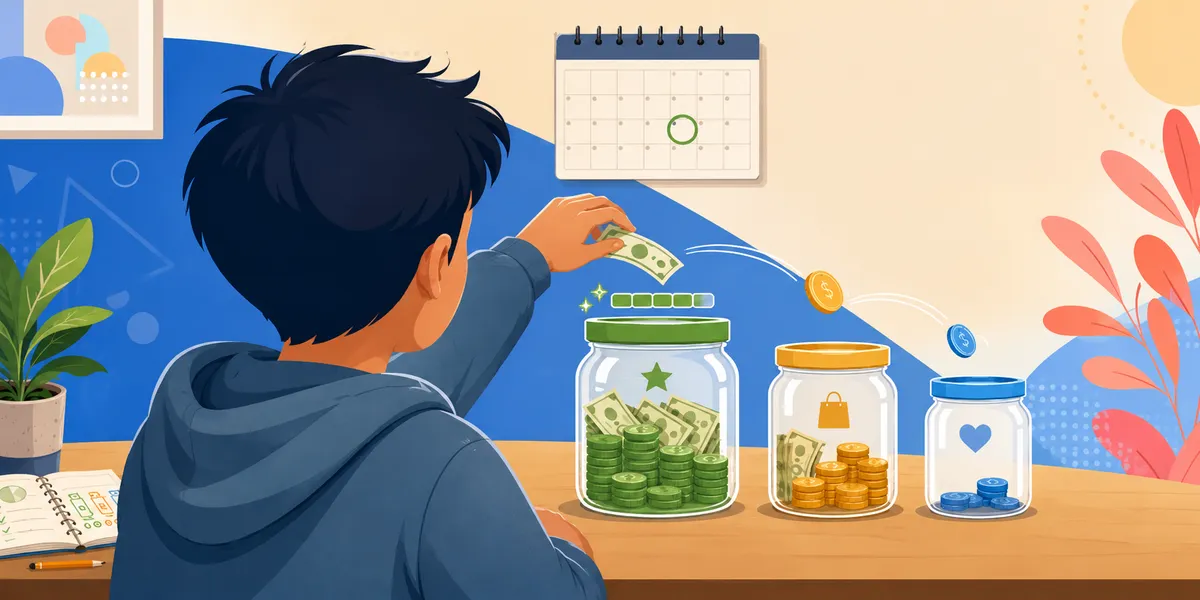
Money in a single pile is just a number. The same money divided into Save, Spend, and Give becomes a decision-making system. Once money is in "Save," it takes a deliberate act to move it back to "Spend," and that small friction is doing real work.
A starter split for a $10/week allowance:
- Save 50% ($5): toward a goal or longer-term holding
- Spend 40% ($4): for in-the-moment small stuff
- Give 10% ($1): for charity or causes they care about
The exact percentages aren't sacred. The point is that splitting happens first, before any decision about what to buy. That's the order that produces savers.
For the deeper version of this (including how to handle goal-based saving and what happens when a kid wants to override the split), see our complete Allowance Guide.
Lessons that teach this in the app
Three real lessons from inside the app. Try them in the demo.
When they spend it all in a day
This will happen. It's not a failure. It's the lesson.
Resist the urge to bail them out or top them up. The whole point of allowance at this age is to let small mistakes happen while the stakes are still tiny. A kid who blows $10 on a soft drink and a trading-card pack at age 10 has just learned something about regret that costs nothing to recover from. A 16-year-old learning the same lesson with a debit card costs a lot more.
What you can do:
- Talk about it, without shaming. "What did you think you'd feel after buying that? What do you feel now?" is more useful than "I told you so."
- Help them name a goal for next time. Concrete future targets ("a Lego set in 6 weeks") beat abstract advice ("save more").
- Hold the line on the next payday. The cadence is the lesson. Skipping it removes the recovery cycle.