In this guide
Loading…
★ Key takeaways
- What to do with Christmas money comes down to one move: split the haul into Save, Spend, and Give the day it lands, before the sales start.
- The exact percentages matter less than making the split a habit. A rough 50 / 30 / 20 works for most kids. Tilt toward Spend for little kids and toward Save for teens with a goal.
- Point the Save part at one named goal. A holiday windfall can cover most of a real goal in a single afternoon, which is when saving starts to feel worth it.
- Gift cards count as money. Total them in, and swap them for cash where you can, so the whole haul runs through the same plan.
- Let the Spend part actually get spent. The aim is a thoughtful split, not a locked box for every dollar.
What to do with Christmas money is one of those questions that feels small until you watch the money disappear. A kid wakes up on the 26th with cash from grandma, a couple of gift cards, and maybe a folded bill from the aunt who mails one every year. By the middle of January, in a lot of houses, most of it is simply gone, and nobody can quite say where. None of that is a discipline problem. It is what happens to any pile of money that shows up all at once with no plan attached.
The fix is not a lecture, and it is not a piggy bank you control. It is a five-minute split the kid runs themselves, on the day the money lands, before the sales get to it. Here is how to do it at every age.
The 5-minute Christmas money plan
If you only do one thing with the holiday haul, do this, and do it the day the money arrives:
- Count it all. Cash plus gift cards, in one number. Gift cards are money too, even though they are stuck to one store.
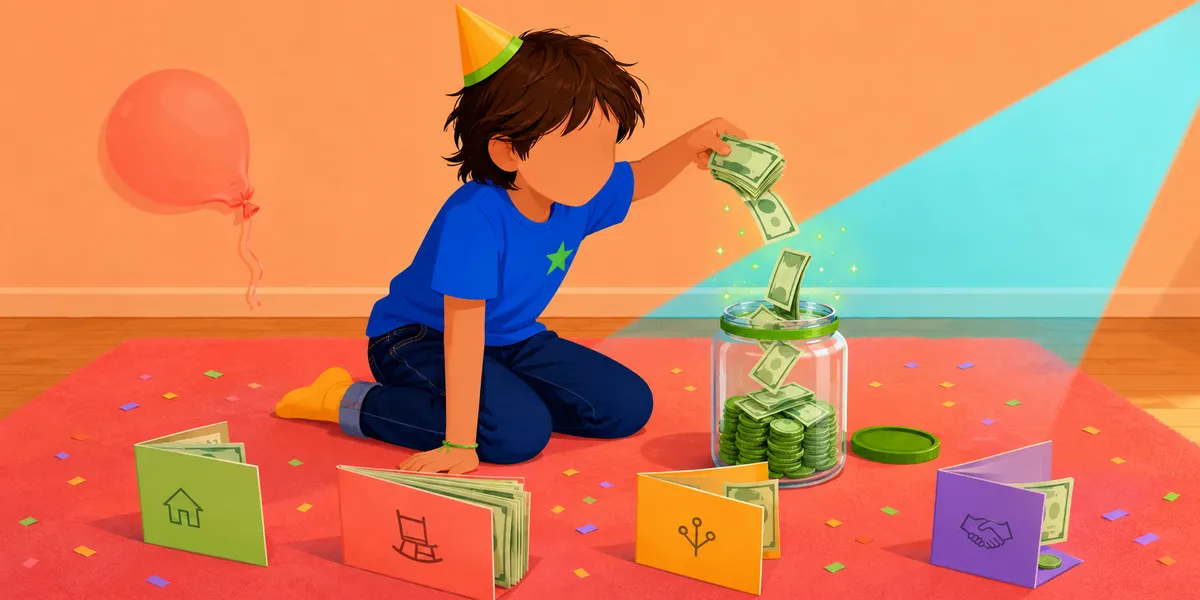
- Split it into Save, Spend, and Give. Three piles, made the same day, before the sales start. A rough 50 / 30 / 20 is a fine place to begin.
- Name one goal the Save pile feeds. Not "savings" in the abstract. One specific thing the kid actually wants.
- Spend the Spend pile on purpose. Let it get spent. Just wait a day first, so it is a choice and not a reflex.
- Pick one place the Give pile goes. A toy drive, a cause, a gift for someone. The kid decides.
A starting split
Tilt toward Spend for little kids, toward Save for teens
Point the Save part somewhere
A holiday windfall fills a real goal in an afternoon
The whole thing takes about five minutes, and it survives contact with reality because the kid runs it, not you. The percentages are a starting point, not a rule. What matters is that the split happens at all, and that it happens before the money has a chance to leak out one purchase at a time. The Consumer Financial Protection Bureau's Money As You Grow milestones make the same point in a broader way: the money habits that stick are the ones attached to a small, repeatable routine, not the ones attached to a big one-time talk.

Why Christmas money disappears by New Year
Here is the part most plans skip. Christmas money is harder to hold onto than the same amount earned over a month of chores, and that is not the kid's fault. Money that arrives all at once, as a gift, tends to feel different from money that arrives a little at a time. It feels like extra, and extra money gets spent more loosely than money that felt like it cost something to earn. Adults do exactly the same thing with a tax refund or a work bonus.
Then the calendar makes it worse. The last week of December and the first weeks of January are one long sale. Every store the kid might spend a gift card at is actively trying to move leftover holiday stock, and the marketing is pointed straight at a kid holding fresh money. A $40 gift card and a bright "everything must go" banner are designed to find each other.
A holiday windfall is the one time all year a kid can watch a real goal jump halfway to full in a single afternoon.
So the timing of the split is doing real work. Splitting on the 26th, before the kid has wandered into a single sale, is a completely different outcome from splitting on January 8th after three "but it was on sale" purchases have already happened. You are not racing the kid. You are racing the calendar. The Save / Spend / Give system is the same approach that works for allowance all year. The holidays just raise the stakes, because the pile is bigger and the sales are louder.
How to split Christmas money by age
There is no single correct split, but there is a shape that works, and it shifts with age. The planner below lets you set the total and slide the three pieces around to see what each one comes to. Try it with your kid's actual haul.
★ Interactive · 30 seconds
Plan the Christmas money
For the youngest kids, roughly ages 6 to 8, tilt the split toward Spend. A six-year-old who has to bank most of their Christmas money learns that saving means the grown-ups take it away. Let Spend be the biggest pile. The lesson at this age is the ritual of making three piles at all, not the ratio. Use real jars or envelopes they can see and touch, or the in-app Save, Spend, and Give jars if you are tracking it on a screen.
From about 9 to 12, the goal becomes the point. This is the age where a kid can hold a specific target in their head and wait for it, so a holiday windfall becomes the fastest way all year to reach it. A weekly allowance of $10 takes more than two months to add up to $100. A Christmas haul can do it in an afternoon. Name the goal out loud, set it as a visible target, and watch the Save pile cover most of it in one go. A savings goal with a progress bar makes that jump visible, which is most of what makes a kid want to keep saving.
For teens, 13 and up, hand the whole thing over. The split is theirs to set, and your job is to ask one good question before they decide, usually some version of "what is this money actually for?" A teen with a real target, a concert, a car fund, the first month of a subscription they want to cover themselves, will often choose to save more than you would have dared suggest. The piece worth protecting at this age is the Save pile, because a teen's spending temptations are bigger and faster than a younger kid's. A Money Vault is built for exactly this: it locks the saved part for a chosen stretch of time and pays out a small bonus when the timer ends, so "I'll save it" survives the first good sale.
Blow it
The whole haul becomes spending money. Fun for a week, gone by mid-January, with nothing to show for it. The common default, and the one the plan is built to replace.
Split it
Save, Spend, and Give piles made the day it lands. The kid still gets to spend, but a real chunk survives the sales. The sweet spot for most families.
Goal it
Most of the haul points at one named goal the kid is chasing. Best when there is something specific they want and the windfall gets them most of the way there.
Most families land in the middle row. The kid still gets a real Spend pile, so the plan never feels like a punishment, but a meaningful chunk gets routed somewhere before it can evaporate.

Lessons that make the split stick
The split is a parent move, and it is one of many. The parent tips guide collects the rest. These three short lessons inside the app are the kid's side of this particular one, with a version for each age band. Run the one that matches your kid sometime in the quiet stretch between Christmas and New Year, when the cards are open and the haul is sitting there waiting for a decision.
None of them takes more than a few minutes, and each one lands harder right now, with real holiday money on the table, than it would as an abstract exercise in March. That is the quiet advantage of teaching this in the season: the example is sitting in the kid's hand.
Gift cards, cash, and the relatives who overshoot
Three situations come up in almost every house.
Gift cards. A gift card is real money with a leash on it. It only spends at one store, which means it skips your Save, Spend, and Give plan entirely unless you do something about it. Two moves help. Where you can, swap the card for cash at home, hand the kid the bill, and let it run through the split like everything else. Where you cannot, treat the card as the Spend pile, already chosen for them, and steer the actual cash toward Save and Give. A card to a kid's favorite bookstore is a fine constrained Spend. A card to a store they barely use is worth swapping.
The day-one spender. Some kids want it gone the moment it lands. You do not have to fight this head on. The move is a single day of delay, not a no. "Let's sort it tomorrow, then you can spend your Spend pile on whatever you want." One night is usually enough to turn a checkout-line impulse into an actual decision, and the kid almost always picks something better the second time they look. If overspending is a steady pattern in your house, the post on when your kid spends money too fast walks through the longer fix.
The relative who overshoots. Grandma hands over $100, your household norm is closer to $20, and suddenly the kid is holding more cash than your whole money setup was built for. The move is to route it, not refuse it. Refusing a gift is awkward for everyone and teaches nothing. Routing it is easy: "That is so generous. Let's put most of it toward your goal." Almost every kid agrees, especially if you offer to match part of what they save. This is the same windfall question that birthday money raises, and the birthday money guide covers the matching move in more detail. Whatever you do, keep it predictable across siblings, so the younger kid is not quietly learning that the rules change with the amount.