In this guide
Loading…
★ Key takeaways
- How much birthday money to give a kid by age depends on who is giving and how old the kid is. The same $20 reads differently from a parent than from a grandparent.
- Common parent-to-own-kid ranges: $5 to $15 at ages 5 to 7, $10 to $25 at 8 to 10, $15 to $30 at 11 to 12, $20 to $50 at 13 to 16.
- Grandparents typically give about twice what parents do at every age. Aunts, uncles, and family friends usually land between.
- The amount matters less than the household rule. Pick a number you can hold for every kid in the family, every year. Predictability is the lesson.
How much birthday money to give a kid by age is one of those questions every parent eventually Googles, and the honest answer is it depends on who is giving and how old the kid is. No major organization publishes an annual survey of birthday-money amounts the way some agencies survey holiday spending. What does exist is the steady accumulation of parenting-community conventions: $5 to $15 from parents at the youngest ages, climbing to $20 to $50 by the teens. Grandparents typically give about twice that. Aunts, uncles, and family friends usually land between. The widget below sweeps the whole landscape so you can find the amount that fits your situation in about thirty seconds.
The harder part, and the rest of this post, is what to do with the money once it is in the kid's hand.
How much birthday money to give a kid by age: the short answer
If you only have a minute, here is the calibration most households land on:
- Ages 5 to 7. Parents: $5 to $15. Grandparents: $15 to $50. Aunts / uncles: $10 to $25. Family friends: $5 to $15.
- Ages 8 to 10. Parents: $10 to $25. Grandparents: $20 to $50. Aunts / uncles: $15 to $30. Family friends: $10 to $20.
- Ages 11 to 12. Parents: $15 to $30. Grandparents: $30 to $75. Aunts / uncles: $20 to $40. Family friends: $10 to $25.
- Ages 13 to 16. Parents: $20 to $75. Grandparents: $40 to $150. Aunts / uncles: $25 to $75. Family friends: $15 to $40.
By age
$5–$15 at ages 5–7 climbing to $20–$50 by 13–16
The generation gap
Grandparents typically give about twice what parents do
These are common-range conventions, not survey data. The ranges come from parenting-community norms aggregated across BabyCenter, Care.com, Reddit, and similar forums, plus the household calibrations baked into the save-spend-give system post and the existing per-age allowance series. Use them as a starting point and adjust to your household's budget and tradition.
One pattern worth noting before the rest of the post: the relationship dimension matters as much as the age dimension. The same $20 reads as generous from a parent of a 7-year-old and as stingy from a grandparent of the same kid. The widget below lets you toggle the relationship and see the shift instantly.
Who is giving matters: parents vs grandparents vs aunts and uncles
The clearest pattern in birthday-money conventions is that grandparents give roughly twice what parents do at every age. Three reasons land that pattern:
First, fewer mouths to give to. A grandparent with three grandkids gives three birthday gifts a year. A parent with three kids gives three birthday gifts plus weekly allowance plus tooth-fairy money plus the inevitable random asks. The economics differ even at identical household incomes.
Second, generational generosity is a real convention. Most cultures encode it: the grandparent role is loosely "the indulgent one," in a way the parent role is not allowed to be. Birthday money is one of the few socially-sanctioned places that role gets to express itself. Most grandparents enjoy being the bigger giver, and most parents quietly want them to be.
Third, birthdays are once a year. Parents give all year long; the $20 you hand over at the birthday is one of dozens of money-events you will run that year with your kid. Grandparents typically have birthdays, Christmas / holidays, and maybe one or two other moments. Their per-event amount can be larger because the per-year total is smaller. The CFPB Money As You Grow milestones frame this same idea more broadly: the rituals that recur most often shape habits the most, and predictability of those rituals does more developmental work than the size of any single payout.
The amount matters less than the rule you can hold. A kid who learns to expect a steady $10 every birthday is learning more than a kid surprised by $5 or $50.
The "$1 per year of age" rule of thumb deserves a quick sidebar. It is folk wisdom, not survey data, and it works as a floor at the youngest ages ($5 at age 5 is a defensible amount) but under-shoots quickly. By the time the kid is 10, $10 from grandma is below what most grandparents do; by 14, $14 is below what most parents do. The widget below uses a richer set of ranges that track relationship and age together.
★ Interactive · 30 seconds
Birthday money, by age
The matrix in the widget is author calibration, not survey data. There is no authoritative annual survey of birthday-money amounts in the United States. The numbers are the right shape (low-high ranges drift up with age, grandparent ranges roughly double parent ranges, friends and aunts/uncles fill the middle), but the exact dollar in any cell is a starting point, not a benchmark to hit.
Setting the household rule once, holding it for years
The single best thing a household can do with birthday money is pick a rule and hold it. Three tiers cover most families:
Tight
$5 (young) to $20 (teens) from parents, with grandparents at $10 to $40. Predictable across siblings and years.
Comfortable
$10 to $30 from parents, $25 to $75 from grandparents. Tracks most middle-income household conventions.
Generous
$30+ from parents, $75+ from grandparents. Often paired with a separate gift. Set the precedent on the first birthday; the rest take their cue.
Tight. $5 to $20 from parents, $10 to $40 from grandparents. This calibration is sustainable for tight household budgets and large extended families. The kid will not feel under-gifted as long as the amount is the same across siblings and the years. What hurts is variability, not absolute level.
Comfortable. $10 to $30 from parents, $25 to $75 from grandparents. This is where most middle-income U.S. families land. The widget above defaults to this calibration unless you toggle into a different relationship or age.
Generous. $30+ from parents, $75+ from grandparents. Often paired with a separate gift (not just cash). The most important move at this tier is to set the precedent on the first birthday and not escalate. A kid who got $50 at age 5 has a baseline expectation of $50 at age 6 and 7 and 8. Picking a number you can hold for every birthday until the kid leaves home is the actual rule, regardless of tier.
Sibling fairness is the load-bearing constraint at every tier. The amount must be the same per-kid per-birthday across the family. If the older kid got $20 at their tenth birthday and the younger kid gets $30 at theirs, expect a fairness argument that will outlast the gift itself. Predictability is the lesson, both for the household budget and for the kids.
When grandma overshoots the family default, the move is rarely to refuse the gift. The cleaner move is to route it. If grandma gives $100 to your 8-year-old and the household norm is $30, the kid does not need to hold $100 in their hand to spend. The conversation that works: "That is amazing. Want to put it toward a real saving goal?" Almost every kid says yes, especially when paired with a parent match on the saved half (see the FAQ). The Save / Spend / Give system post walks through the jar split that handles this kind of bigger one-time deposit.
What the kid does with the gift money
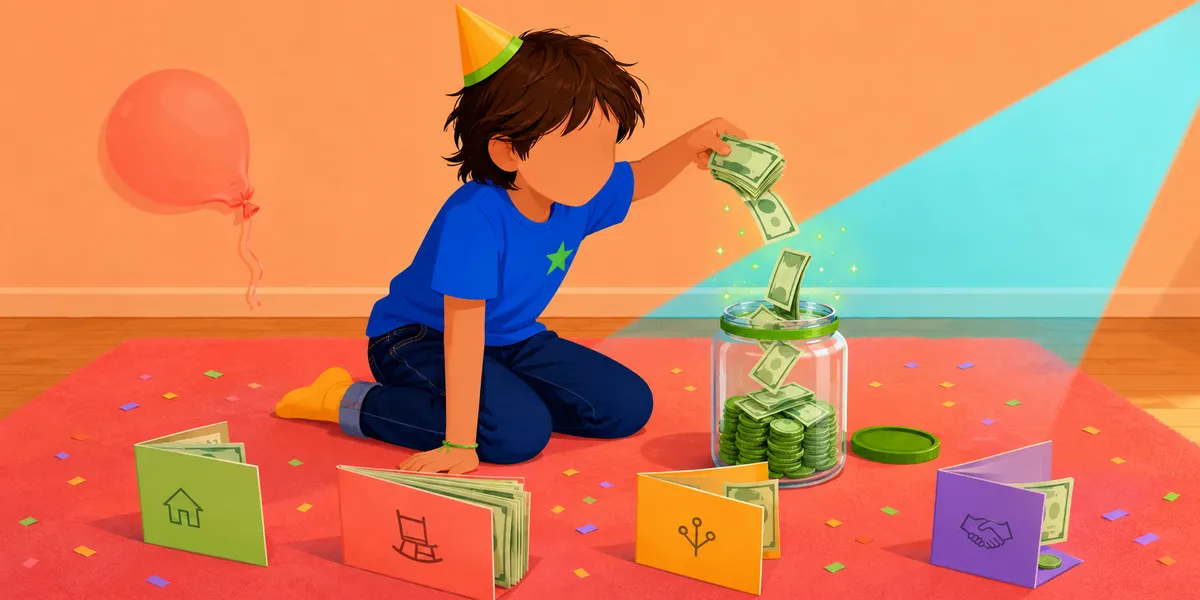
A $30 bill from grandma is interesting at the moment it lands. The teaching happens in the next twenty minutes, when the kid decides what to do with it.
Three lessons inside the app teach the kid side of this same arc. Pair them with the birthday-money moment. Each one is short and runs cleanly as a post-cake activity once the cards have been opened.
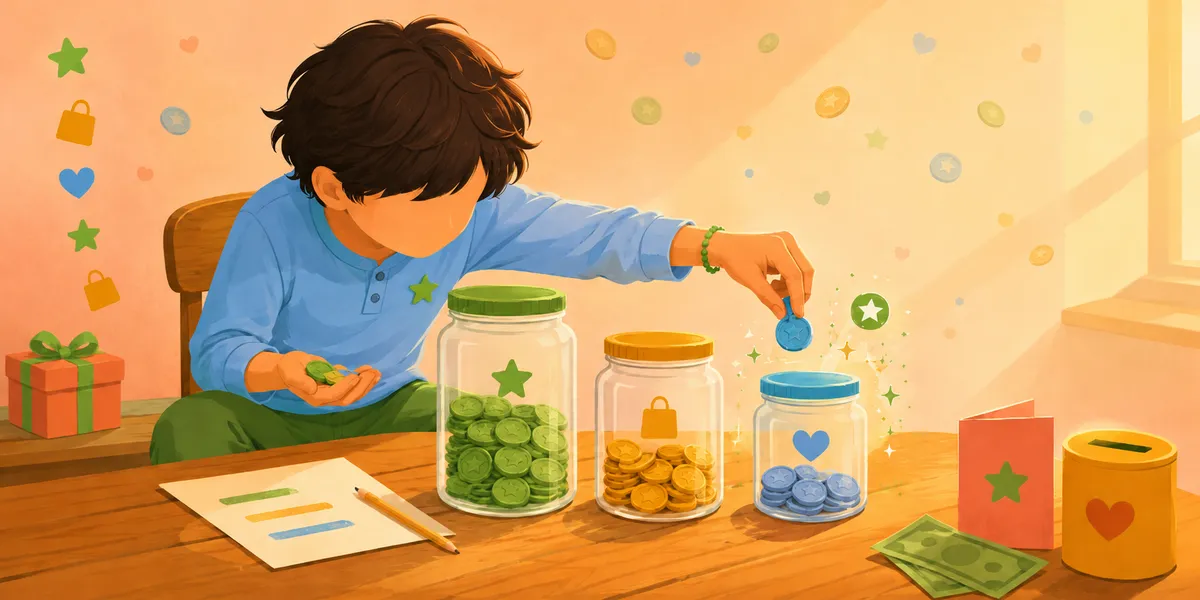
A practical pattern that works for most households: when the kid first holds the cash, do not rush to sort it. Let them feel the bill, count it, talk about it. Then sit down later that day with the three jars (or three envelopes, or the in-app Save / Spend / Give bucket system) and ask the kid where they want each piece to go. At six, they will probably put most of it in Spend. That is fine. The point is the ritual, not the ratio. Across the next ten birthdays, the Save jar starts winning more of the share, especially when there is a real goal the kid has named themselves.
For a kid old enough to have a savings goal, birthday money is the single biggest catalyst the year offers. A weekly allowance of $10 takes ten weeks to hit $100. A birthday haul of $80 from grandma plus $20 from parents gets there in an afternoon. The widget at the top of this page shows the typical haul; the kid's goal jar shows what they can do with it. Connect the two out loud.
When the relatives don't coordinate: the awkward parts
Two awkward dynamics show up in most multigenerational households.
The under-gifter. One set of grandparents gives $50; the other gives $5. The kid notices, often before anyone is ready for the conversation. The fix is not to fix the gap. It is to name the dynamic flatly without moral framing: "Different families give different amounts. Both grandma A and grandma B love you the same. The amount is not the love." Kids absorb this faster than parents expect, especially if you say it once, calmly, before they ask.
The over-gifter. The classic case: grandma slips a $100 bill, household norm is $20, the kid is suddenly holding cash that bypasses every existing money structure in the house. The move is to route, not refuse. Most grandparents respond well to "Could you send a smaller amount on the day, and put the rest in their savings? She is working toward a [goal]." Some grandparents will not. The fallback is the conversation with the kid above: the $100 goes into the Save jar that afternoon, with a parent match on whatever portion the kid agrees to save.
The divorced-household variant is the hardest. When each side competes on birthday amounts to feel like the better parent, the kid is the one paying the cost. The fix is rarely escalation. The fix is alignment: a single text between the adults a few days before, settling who is giving what, ideally with the same household-rule logic both sides can hold across years. If alignment is not possible, the kid-facing move is the same as the over-gifter case: route the larger gift to a goal, hold the household rule on what is spendable now.
A note on cash-vs-gift trade-offs. Cash is more flexible (the kid decides), more visible (you can see the jar deposit), and more teachable (it works with every existing money structure). Gift cards lock the kid into a specific retailer and bypass the jar system. A few specific gift cards are worth their weight (a teen's favorite store, a younger kid's bookstore credit), but in general, parents asking what to give should default to cash and let the kid allocate. The needs vs wants activities post covers the related decision of how to coach the Spend allocation once the cash is in the jar.