In this guide
★ Key takeaways
- How to teach kids to save money is mostly about five repeatable parent moves: name the goal, make it visible, match the first dollar, set a default rate, and celebrate the milestone.
- The five moves work at six, ten, and fifteen. Only the numbers change.
- Visibility does more of the teaching than any lecture. A jar your kid walks past beats a balance they cannot see.
- A small parent match on the first deposit is not a bribe. It is the celebration that makes the second deposit feel inevitable.

How to teach kids to save money is one of those parenting questions where the advice almost never lands. Save first. Set a goal. Be patient. Most parents have heard all of it; most kids still spend every dollar on the way home from the store. The problem is not the advice. The problem is that nobody hands you the five small moves that turn the advice into a habit. This post is the five moves. The advice this post does not duplicate, with links: the three-jar Save/Spend/Give system covers the structural split; teaching delayed gratification covers the patience side; the teaching by age pillar covers what works at each developmental stage.
What's left is the action sequence, and that's the part this post owns: the same five parent moves at six, at ten, and at fifteen. The numbers change as the kid grows, but the moves don't, and that consistency is what turns saving from a project you keep restarting into a habit your kid eventually runs without you.
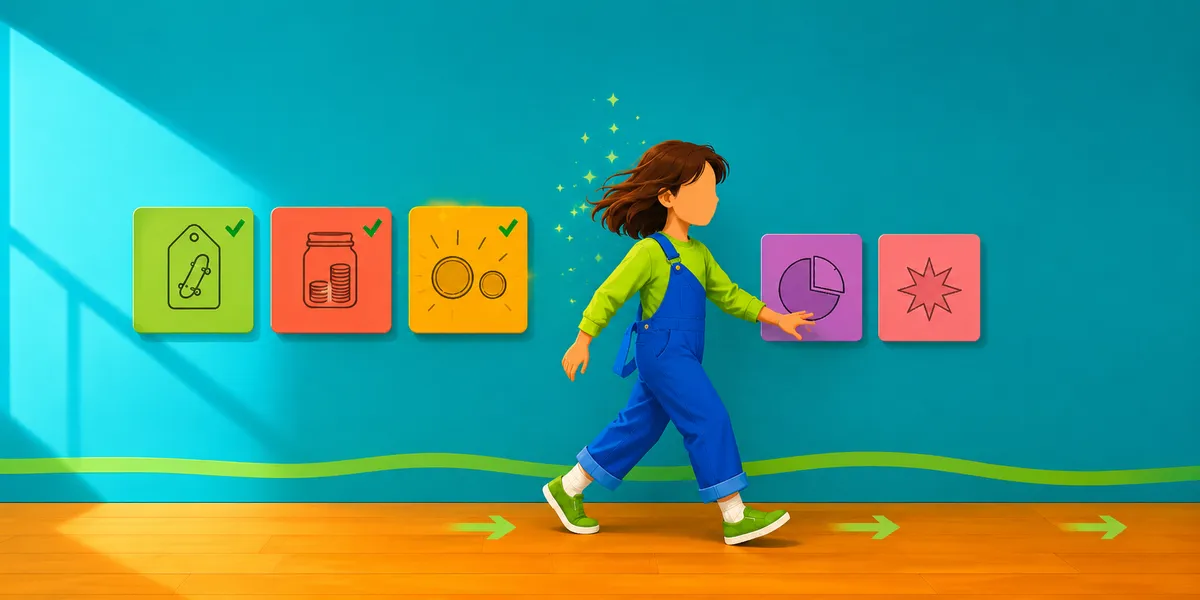
The five moves that make saving stick
Most parents who succeed at teaching saving are running some version of these five moves at the kitchen table, even if they've never thought of them as a list. Most parents who feel stuck are missing two or three of them and don't know which. The first useful thing you can do today is read the five below, mark which ones you already do well, and pick the missing one to set up this week.
- Name the goal. A specific thing the kid wants, with a price tag and a place to write it down. Not "save for the future." Saving for a real $20 thing this month.
- Make it visible. A jar that fills, a progress bar that grows, a sticker chart on the fridge. The kid has to walk past their own progress on the way to dinner.
- Match the first dollar. A small parent match (a dollar, a doubled deposit, a one-time bonus) on the first contribution. Just once. The first deposit becomes a small celebration instead of a small task.
- Set a default rate. The save portion comes out of every allowance before the kid sees it. A decision the kid makes once is easier than a decision they make every week.
- Celebrate the milestone. When the goal lands, mark it. The kid says how it felt before they pick up the thing.
The parent playbook
Same five moves at six, ten, and fifteen
On the first deposit
Small match, large signal
The CFPB's Building Blocks model places ages 6 to 12 in the "developing financial habits and norms" stage, and the five moves above are how that habit actually gets built in your kitchen. The mistake most parents make at month three is judging the lesson by how full the jar is. The amount in the jar is downstream of the routine. A kid who has run all five moves on a $20 goal for two months has done more saving learning than a kid who happens to have $200 in an account someone else set up for them, because the second kid hasn't practiced anything; they've just been the beneficiary of an adult's habit. The number follows the practice, every time.
The advice on saving is right almost everywhere. The execution is what is missing, and the execution is five moves you can run this week.
Why naming and visibility do most of the work
Two of the five moves are doing most of the teaching: naming the goal, and making it visible. Everything else amplifies them. Both are concrete-thinking levers, which matters because young kids think in things they can hold and see. Whitebread and Bingham's Cambridge study on habit formation found that money habits set in the early-school years, roughly by age seven. What "setting" looks like at that age is concrete: a coin goes into a labeled jar, the jar fills, and the kid sees it fill. Everything else parents do to teach saving for the next decade (the conversations, the matching, the celebrations, the eventual transition to an app) sits on top of that one mental image. Most of the savings strategies that fail with young kids fail because the parent skipped this layer and went straight to an invisible account, which at age six or seven might as well not exist. The kid can't picture a number on a screen they can't see, so the saving stops feeling like anything.
The widget below is the five moves in playbook form. Tap a step to see the why, the parent script, and how the same move shows up on the kid's side of the app or at the jar. Use it as a checklist for the goal you are about to set with your kid this week.
★ 5 moves · 60 seconds
The saving playbook
The Cambridge research, and the Money As You Grow milestones that line up with it, are clear about one thing: the routine matters more than the amount. A kid who runs the five moves on a $20 goal does more saving learning than a kid who runs zero moves on a $200 goal someone else set for them. The advice about teaching children to save money has been right for decades. The execution is what the corpus is missing.
The five moves at six, ten, and fifteen
The same five moves run at every age, and the conversation around them looks remarkably similar at the kitchen table whether your kid is in first grade or tenth. What changes is the scale: the size of the goal, the length of the wait, the shape of the visibility, and how much of the work the kid does without you. Here is what each of the three checkpoints actually looks like in a home where the playbook is running well.
At six, the goal is a $5 to $15 thing the kid can hold (a small toy, a craft kit, a small Lego set). Visibility is a glass jar on the kitchen counter or a sticker chart. The match is a single dollar on the first deposit. The default rate is whatever percentage of a small weekly allowance the kid agrees to drop in the jar. The milestone is the trip to the store to get the thing, with a sentence or two about how the wait felt. The age-6 foundations guide goes deeper on what a six-year-old can hold.
At ten, the goal is a $30 to $100 thing that takes weeks (a real game, a real bike accessory, a school-trip fund). Visibility is a labeled Save jar or a Savings Goals progress bar in the app the kid can refresh. The match is a doubled first deposit, or a one-time bonus tied to the goal. The default rate is the 50/40/10 split moving automatically out of every allowance. The milestone celebration is the same as at six, with more reflection. By ten the kid can also start naming what they would do differently next time, which is the first version of meta-learning about saving. The age-7 price-tag guide covers the inflection point a few years earlier.
At fifteen, the goal is a $200 to $500 thing that takes months (a phone, a guitar, a contribution toward something the teen is co-funding). Visibility is the app dashboard the teen checks themselves; the jar metaphor mostly retires. The match is parental, but small and time-limited (a 1:1 match up to $50 on a specific goal, not an ongoing subsidy). The default rate becomes an explicit conversation about percentages of any income, not just allowance. The milestone celebration is private, low-key, and ideally led by the teen ("I did this myself" lands better than "Mom and Dad are proud of you"). At every age, the moves are identical; the numbers and the framing scale up.
Lessons that teach this in the app
Three saving lessons, one per age band, that practice the moves the playbook just covered. Try them in the demo to see what shows up on your kid's account.
When saving stops working, and the move to make instead
Three things go wrong with saving more often than anything else, and parents almost always reach for the same reflex when they do: try harder, talk more, pep-talk through it. None of those work, because the failure is rarely about motivation. Each of the three is structural, which means the fix is to find what's missing or out of position in the five moves, not to add a sixth move called "convince the kid to care."
The kid hits the goal and then loses interest. This one looks like a failure but isn't. The whole point of a named goal is that the kid arrives at it and the saving energy resets to zero, and that reset is by design. The mistake parents make here is treating the empty jar as the end of saving instead of the start of the next cycle. Don't let more than a few days go by between the celebration and naming the next goal. Ideally you sit down together on the trip home from the store with the first thing in the bag and ask, on the drive, what they want to save for next. Saving without a current named goal is the hardest version of saving at any age, because you've gone back to the abstract version of the work that none of the five moves can rescue you from.
The kid agrees to the goal but never makes a deposit. This is almost always a visibility problem, even when it looks like a motivation problem. Walk through the house and time how long it takes you to spot the jar (or the chart, or the app icon on a screen the kid actually opens). If the answer is more than a few seconds, the kid hasn't seen it either, and a goal you can't see is the same as a goal you never named. Move the jar back to the kitchen counter, or pin the chart to the fridge at kid-eye height, or put the app shortcut on the home screen. If the kid still doesn't start after a week of restored visibility, the goal itself is probably the issue: too big, too vague, or not actually what they want anymore. Swap it without making a thing of it. Swapping is a normal part of saving at six or seven and isn't evidence the kid lacks commitment. The fuller diagnostic side of "my kid just won't save" lives in my kid spends money too fast.
The parent who comments on every deposit. This is the easiest of the three to fall into and the hardest to see in yourself, because over-narrating saving comes from a real and good parenting instinct: you watched your kid put the dollar in the jar, you noticed, and you want them to know you noticed. The problem isn't the noticing. It's the marking. A weekly deposit that gets a small comment every single time turns the deposit into a check-in with you, and within a few weeks the kid is doing the saving for your audience instead of for the goal they named. The fix is to trust the structure you spent the first four moves setting up. The named goal does the lecturing for you. The visible jar or progress bar does the lecturing for you. The matched first dollar already did the celebrating. Your job, from that point forward, is to notice when the jar gets moved, not to comment when it fills. A working rule of thumb: if you find yourself saying anything aloud about saving more than once a week, the structure has gone slack somewhere. Look for the move that's missing or has drifted out of position, and put it back.