★ For parents of first graders

Teaching a 7-year-old about money: the price-tag year

Teaching a 7 year old about money: the price-tag year, when reading the price, doing the subtraction, and making the call all start working at the same time.

Sprout Saver Team · 7 min read
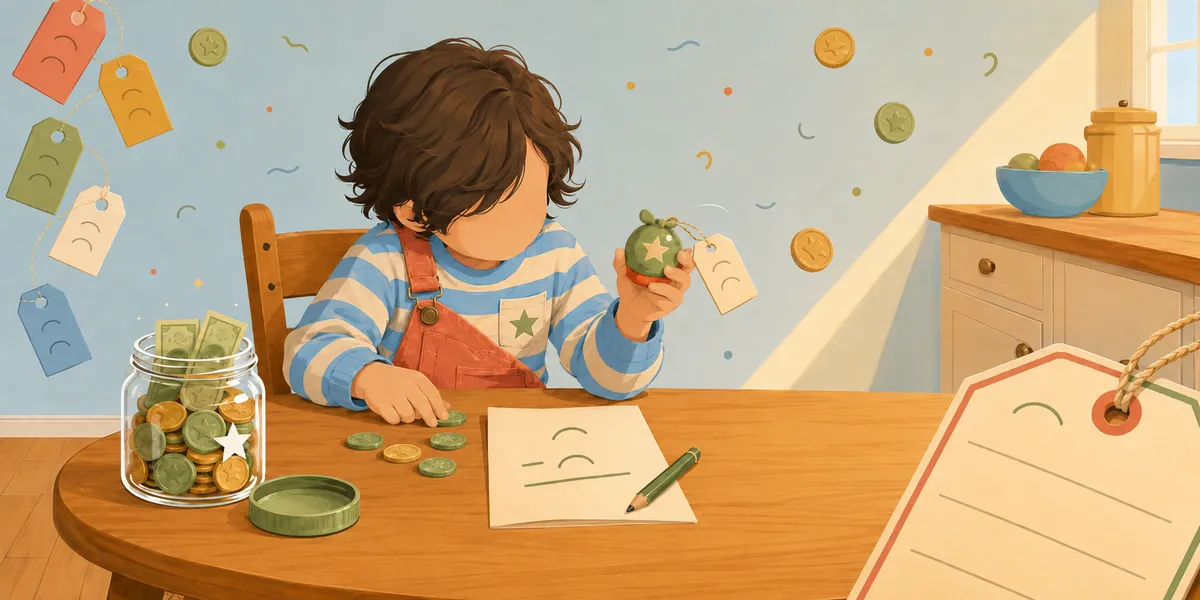
A faceless 7-year-old in a blue and white striped long-sleeve shirt under coral overalls with a green star on the pocket, sitting at a wooden kitchen table inspecting a small green star coin attached to a price tag. A jar of green and gold coins sits to the left; coins are spread on the table next to a sheet of price-tag practice drawings and a green pencil. Several price tags hang from strings in the background, some empty and ready to be labeled. The price-tag-reading year.
In this guide

★ Key takeaways

  • Teaching a 7 year old about money is the price-tag year. Reading the tag, doing the subtraction, and making the call all start working at the same time.
  • Three skills click around age 7: reading $1.25 on a tag, holding the math in mind, and choosing between two things they want.
  • One earnable chore at this age, not five. The point is the agreement, not the chore-chart maximization.
  • Concrete-operational thinking shows up around 7. The jar of coins still works, and now the kid can also read the receipt.

Teaching a 7-year-old about money is the year it stops being a foundation problem and starts being a literacy one. At six, your kid was learning that coins are real, jars are buckets, and waiting is something they can survive. At seven, the kid in the cereal aisle can suddenly read the price on the box, do the subtraction against what's in their hand, and tell you whether they can afford it. Three skills click at once, and the kitchen-table conversation gets a lot more interesting.

This is the age-7 chapter of the broader teaching-kids-about-money-by-age playbook. The 6-year-old chapter covered what foundation looks like; this one covers what comes next, which is the year the price tag becomes real.

What clicks at seven

Most of what makes a 7-year-old's money education work is the three things that suddenly fit together. Each one was emerging at six. At seven they start landing on the same day.

  1. Reading prices in dollars and cents. "One twenty-five" on a tag becomes legible: one dollar before the dot, twenty-five cents after. The decimal point clicks.
  2. Doing the subtraction. What's in the jar minus what the thing costs equals what's left. Two-digit subtraction is a first-grade skill in most curricula; money is what makes the worksheet land in real life.
  3. Holding a small goal for days, not minutes. A $10 thing they want, broken into a $2-per-week save plan, becomes a five-week plan they can stick with.
  4. One earnable chore at an agreed amount. Not five chores, not a chart, not optimization. One thing they say yes to, that they do, that they get paid for. Agreement is the curriculum at this age.
3skills

What clicks at seven

Read the price, do the subtraction, make the call

1chore

First earnable job

One agreed chore at an agreed amount

The CFPB's Building Blocks model places ages 6 to 12 in the "developing financial habits and norms" stage and is specific that the habits set in the early-school years are the foundation the later decision-making skills get layered onto. Seven is dead center of that window. The decisions a 7-year-old practices at the kitchen counter and the cereal aisle are the routines a 12-year-old is still running, with bigger numbers attached.

Why seven is different from six

A six-year-old can sort coins, fill jars, and tolerate waiting if waiting is visible. What they can't reliably do yet is hold two abstract numbers at once. The price tag says $1.25; the jar has $3. To figure out what's left after the purchase, the brain has to keep both numbers in mind and run the operation between them. At six, that's a stretch. At seven, in Piaget's framing, concrete-operational thinking has started showing up, and the second number stops slipping out of the kid's head halfway through the subtraction.

At seven, the jar of coins still works, and now the kid can read the receipt too.

The other shift is identity. At six, money mostly happens to the kid: someone hands them coins, they put them in a jar, the jar fills. At seven, the kid starts seeing money as something they have, that gets used, that gets earned back. Whitebread and Bingham's Cambridge study on habit formation puts the habit-setting window at roughly ages 3 to 7, with the seventh year as the rough cap. Whatever attitudes about money your kid has internalized by their seventh birthday are the ones the rest of childhood will keep building on. That's not pressure; it's permission to keep the conversations small and frequent, because the routine is the lesson.

What this means at the dinner table: keep the jars and the sticker charts that were working at six, and start adding the explicit subtraction step in front of the kid. "You have three dollars. That candy bar is one twenty-five. So if you buy it, you'll have…?" Wait for the answer. They will surprise you within a month.

The price-tag year: what to do at the kitchen table

At seven, the kitchen-table playbook gets three new moves. Each one takes thirty seconds and replaces a longer conversation.

Read

Recognize $1.25 on a price tag. Say it out loud: one dollar and twenty-five cents. The literacy moment happens at the shelf, not on a worksheet.

Count

Subtract the price from what's in the jar. Hold both numbers in mind for a few seconds. By 7, most kids can do this on their fingers, then in their head.

Choose

Pick one of two things they want, without melting down. The choice itself is the lesson. The thing they pick is for them.

Read the price out loud. Whenever your kid sees a tag, ask them to say it. "What does that one say?" Not as a test; as a habit. The skill is recognizing the dollar sign, the decimal, and the cents. Most 7-year-olds get it the first time you ask and then forget; by the tenth time, they read tags on their own without prompting.

Count out the dollars together. When they're spending from their jar or their wallet, have them count it out. Not all at once; pile by pile. Bills first, then quarters, then dimes. The point is the count, not the speed. Once they're confident counting out three or four dollars, slip in a single cent or nickel so they have to keep the column straight.

Let them make the call. Two items, one budget, one decision. The choice itself is the lesson. Don't pre-narrate which one is better; let them work it out. If they pick the one you privately think is worse, the regret is the curriculum. Eight is when they start remembering the regret. Seven is when they start collecting it.

The widget below makes this visible. Set the kid's pocket money on the slider, look at the three priced items together, and try the conversation with them in the room. The math is small enough to do live; the choice is small enough to walk away from.

★ Interactive · 30 seconds

What can a 7-year-old afford?

Lessons that teach this in the app

Three real lessons that practice the year-7 skills. Try them in the demo to see what shows up on a 7-year-old's account.

When the wheels come off, and what to do instead of fixing it

Three predictable 7-year-old moments. Each one is recoverable without a lecture.

They want something they can't afford. Read the price together. Subtract from the jar. If the answer is no, say the number out loud: "You have $3, that costs $7, so we need $4 more. That's two more weeks." The math is the no. You don't have to add anything else.

They do the subtraction wrong. Resist correcting it on the spot in the store. Let them buy what they thought they could afford; when the change comes back lower than expected, the receipt does the correction for you. Save the explanation for the car ride. By eight, the kid will catch the mistake themselves. (For the broader allowance-side mechanics at age 7, see the 7-year-old allowance guide.)

They change their mind mid-aisle. Fine. They can change their mind. The rule is: once the money leaves the jar, the choice is locked. So the chair before the cash register is the chair where they decide. If they're standing in front of the candy with one in each hand, that's the moment for the question, not the lecture. Sprout Saver's Save jar (the saving slot in the optional Save/Spend/Give bucket setup a parent turns on per kid) makes this concrete: jar money is reserved, and the kid can see it sit there even when the toy is right in front of them.

When the chore-side equivalent comes up (kid skips the one earnable chore, kid wants more money than the chore pays), the same structural answer applies: the agreement is the agreement. Photo Proof and the Chore Management Approval Workflow handle the rest without the conversation having to happen in real time. The growing-up version of this same skill shows up in the 6-year-old foundational guide, which covers the year before any of this clicks.

Things parents ask us

By the end of first grade, most kids can read a price written in dollars and cents, subtract that price from a small amount of money to see what's left, count coins up to a dollar, and choose between two things they want without falling apart. The CFPB's Money As You Grow milestones put exactly these skills in the 6 to 8 age band, and 7 is when they tend to click for the first time.

Ready?

Price-tag year, captured in an app.

Sprout Saver's price-reading lessons and Spend-jar tracking turn every store trip into a teaching moment a 7-year-old can actually log.

Get Started Free

More to read