In this guide
★ Key takeaways
- How to explain inflation to kids: skip the economics and show the shrinking candy bar. The lesson is what their money buys, not what a chart says.
- At nine, inflation is the candy bar that costs more than it used to. At fifteen, it is the reason money left sitting still quietly loses value.
- Prices rising a few percent a year is normal and expected. The Federal Reserve actually aims for about 2% a year.
- Saving still wins, but only if the money grows. Cash in a drawer loses buying power; money that earns a reward keeps up.
How to explain inflation to kids is one of those money talks that sounds harder than it is, mostly because we remember inflation as a word from the news rather than something we could actually see. The good news is that your kid already feels it. The candy bar that cost less a couple of years ago, the game that crept up in price, the snack machine at the pool that keeps wanting more coins. Inflation is just the slow, steady fact that most things cost a little more each year, which means the same dollar buys a little less. The CFPB's Building Blocks model puts the idea that money changes value over time squarely in the 9-to-12 years, which is exactly when the candy-bar version of this lands.
The work after that is keeping the picture honest as your kid gets older. At nine it is a candy bar that costs more. At twelve it is the bigger number on the price tag and a first real sense of percent. At fifteen it is the reason money left sitting in a drawer quietly loses value while prices keep moving. Same idea, three resolutions.
Why prices go up, in one minute
If your kid asks why everything costs more, you do not need a degree in economics to answer well. Here is the whole thing in a few plain bullets, short enough to say in the car.
- More money chasing the same stuff. When people have more to spend than there are things to buy, sellers nudge prices up.
- It costs more to make things. When wages, materials, and shipping cost more, the price of the finished thing follows.
- A little is normal and expected. Prices creeping up a small amount each year is healthy, not a crisis. The Federal Reserve aims for about 2% a year.
- The dollar does not shrink. What it buys does. A five-dollar bill is still five dollars next year. It just fills a slightly smaller cart.
- Saving still wins, if the money grows. Money that earns a reward can keep up with rising prices. Cash in a drawer slowly falls behind.
What normal looks like
Roughly the long-run U.S. average; the Fed targets 2%
What inflation actually is
The dollar stays; what it buys shrinks
The single most useful move a parent can make here is to stop explaining inflation as a number and start showing it as buying power. A kid who hears "prices rose 3%" learns nothing they can feel. A kid who sees that the same allowance buys one fewer pack of cards than it did last year has understood inflation completely. The Federal Reserve's own teaching materials define inflation as a general, sustained rise in prices across the economy, and they teach it to students the same way: compare what a dollar bought then to what it buys now.
Inflation is not a number on the news to your kid. It is the candy bar that used to cost less.
The shrinking candy bar, the bigger number, by age
The picture works at every age this topic is appropriate for, but the version of it shifts as your kid's brain shifts. Below is what each version looks like at the kitchen table, with a short way in for each.
The shrinking candy bar, at age 9
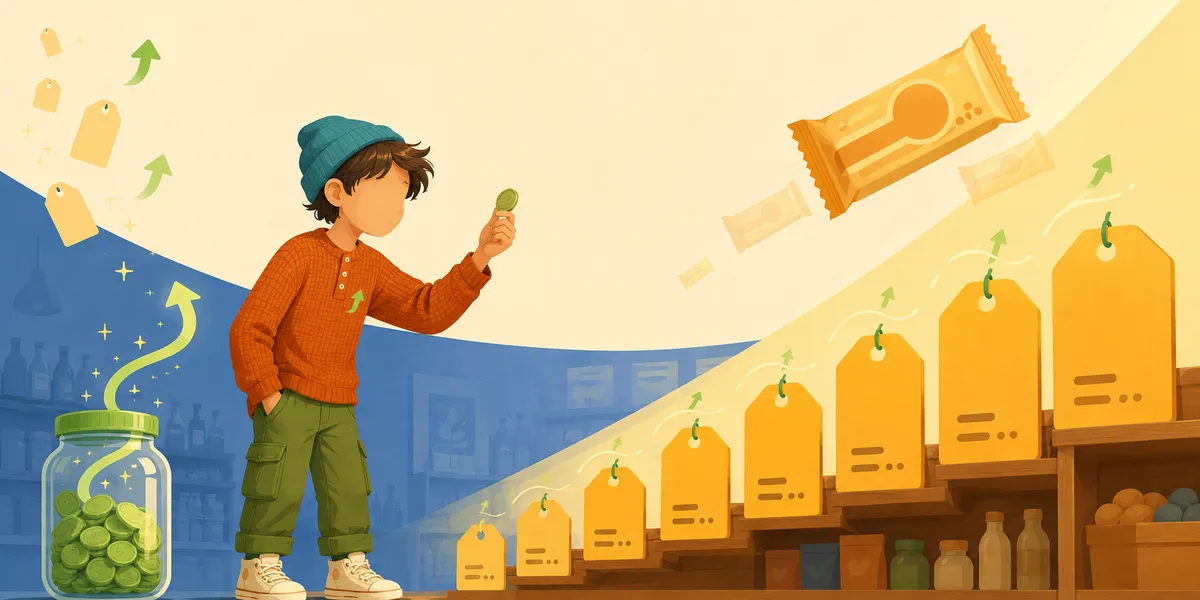
The same treat costs more than it did a year or two ago. The dollar in their hand did not change. What it buys did. That is the whole idea at nine, and a kid can spot it on a shelf.
The bigger number on the price tag, at age 12
Prices creep up a small amount most years. A twelve-year-old can grasp percent, so you can name it: a few cents on the dollar each year, year after year, adds up.
Why sitting still loses, at age 15
If prices rise and the money does not grow, the money quietly falls behind. By fifteen the lesson is real versus nominal: a balance can go up in dollars and still buy less.
At nine, the candy bar is enough. The same treat costs more than it used to, and the coins in their hand did not change. You do not need a percentage at this age. You need the shape of the change: things slowly get more expensive, and that is normal. A nine-year-old who can point at a shelf and tell you "that costs more than last time" has the concept. The Money As You Grow milestones put this kind of price awareness right in this band.
At twelve, the price tag becomes a number you can name. A twelve-year-old can hold percent, so you can be specific: prices tend to rise a few cents on the dollar each year, and those small rises stack up year after year. This is also the age to introduce the honest twist that catches most adults off guard. A small amount of inflation is on purpose. It is not a sign something is broken. Naming that early saves your kid from the cable-news version where inflation is always a disaster.
At fifteen, the lesson is why sitting still loses. By this age a teen can hold the punchline: if prices rise and your money does not grow, your money buys less over time even though the number in the account looks the same. This is the difference between the real value of money and the nominal number, and it is the entry point for every later conversation about savings rates and investing. The teaching-by-age guide places this framing in the 14-to-18 band, where it pairs naturally with a first real savings account.
What to actually say at the table
A lot of parents we talk to understand inflation fine and then freeze when their kid asks a follow-up that needs a number or an example. So here is the scripted version at each age, with the example already in place. The point is not to read it aloud. The point is that you have heard a good answer once before the question lands.
At nine, the script is the candy bar. "You know how a candy bar used to cost less? It costs a bit more now. Your dollar is still a dollar. The candy bar just got more expensive. That slow change, where most things cost a little more each year, has a name. It is called inflation. It is normal, and it is why saving up for something big is smarter than letting money sit around."
At twelve, the script adds the number. "Prices usually go up a small amount every year, just a few cents on the dollar. It does not sound like much, but it keeps happening, so over a bunch of years it adds up. A little of this is actually healthy for the economy. The people in charge of money try to keep it slow and steady, around 2% a year, instead of zero or wild."
At fifteen, the script is real versus nominal. "Say you save a hundred dollars and just leave it in a drawer. In ten years it still says a hundred dollars, but prices went up, so it buys less than it does today. The number did not shrink. Its buying power did. That is why money you are saving for years should sit somewhere that earns a return, so it at least keeps up with prices instead of quietly falling behind."
The Time Machine below lets you and your kid put real numbers behind any of these scripts. Pick something they actually buy, set how fast prices rise, and watch what the same dollar does over the years. Then look at the two lanes underneath: cash that sits still versus money that earns a reward.
★ Interactive · 30 seconds
What will that cost when they grow up?
The habit you are building here is "look at what your money is doing, not just how much of it there is." A kid who has watched the same five dollars buy less over a few years has a feel for inflation that no definition will produce on its own.
Lessons that make inflation click
The three in-app lessons below teach the same picture in a form a kid can play through on their own. The first takes the idea head-on, the next two build the buying-power and growth instincts that inflation depends on. Try them in the demo to see what shows up on your kid's account.
The compound interest explainer is the natural companion to this one. Inflation is the headwind; compound growth is the tailwind. A kid who understands both at once understands why money should keep moving rather than sit still.
When saving isn't enough: how to actually beat inflation
If you have taught your kid to save and then read that inflation eats savings, you are right to feel the tension. Here is the honest resolution, because a teen will spot a fairy tale immediately.
Cash that sits still does lose buying power. A bill in a drawer keeps its number and loses its reach. That is real, and pretending otherwise costs you trust. The fix is not to stop saving. The fix is to save somewhere the money grows, so it at least keeps pace with rising prices. For most kids that starts with a savings account or a rewarded balance, and over many years it grows into investing.
The trap to name out loud is that real kids' savings rates are usually small, often smaller than inflation in a given year. So a young saver can technically be earning a reward and still be losing a little ground to prices. That is not a reason to quit. It is the reason the long game matters, and the reason a higher-growth option becomes part of the plan as your kid gets older. Be straight about the difference between the number going up and the buying power going up. That distinction, the real versus the nominal, is the most grown-up money idea a teen can carry out of this conversation.
Inside Sprout Saver, the everyday version of this is a Save jar paired with the Monthly Savings Rewards, where a parent sets a small reward rate so the balance visibly grows instead of just sitting. The point is less the exact rate and more the mechanic: money that earns something is money that is trying to keep up. The save-money parent playbook covers how to route part of every allowance into that growing balance automatically, which is the routine that gives the lesson something real to stand on.