In this guide
★ Key takeaways
- Are loot boxes gambling? Structurally, yes. You pay real money for a random reward, which is the same core loop as a slot machine, even when the law does not call it gambling.
- Loot boxes and gacha are the random-reward version of in-game spending. Skin gambling is the riskier cousin, where teens bet real-value items on third-party sites built to look like a game.
- The odds are the whole story. A 1% pull means about 100 tries on average, and one unlucky run in ten costs far more than that before a single rare item drops.
- You do not have to ban the game. A spending cap, a 24-hour wait, and turning a random pull into a saved-for goal handle the risk without the fight.
Your kid has just opened their ninth crate in a row, the rare skin still has not dropped, and they are asking, with total sincerity, for five more dollars because this time feels close. If you have stood in that moment, the question underneath it is the one this guide answers: are loot boxes gambling, and how worried should you be about the money? The honest version is that loot boxes, gacha pulls, and skin gambling sit on a spectrum, from "annoying but mostly harmless" to "this is a real bet your child cannot legally make." Here is how to tell them apart, the odds math the pull screen quietly hides, and a calm playbook that does not require banning the game your kid loves.
Are loot boxes gambling? The honest answer
Lots of parents ask this the first time a kid begs for "just one more" of something they cannot quite see the price of, and it is a fair question, because the answer is genuinely split. Structurally, a paid loot box does the same thing a slot machine does. You put in real money, the outcome is random, and the prize you actually want is rare. A team of researchers writing in Nature Human Behaviour reviewed loot boxes across 22 games rated for players 17 and under and concluded they are "psychologically akin to gambling." In law, though, most countries still do not classify them as gambling, usually because the prize cannot officially be turned back into cash.
So the useful test is not "is this technically illegal." It is whether the mechanic has the four features that make gambling pull on a kid's brain:
- Real money goes in. Directly, or laundered through gems, coins, or V-Bucks that you bought with real money first.
- The outcome is random. Your kid does not choose what they get. A hidden number does.
- The prize they want is rare. The math is tuned so the good item lands far less often than it feels like it should.
- Sometimes it can be cashed out. Skins and rare items with resale value cross the line from spending into wagering.
A mechanic with the first three is gambling-shaped. Add the fourth and it is gambling in everything but the legal paperwork.
What a 1% drop really costs
Average tries for one rare item
Loot box, gacha, skin betting
Same random core, rising risk
The three words parents hear most are loot box, gacha, and skin gambling. They are not the same thing, and the differences are exactly what decide how worried to be.
Loot box
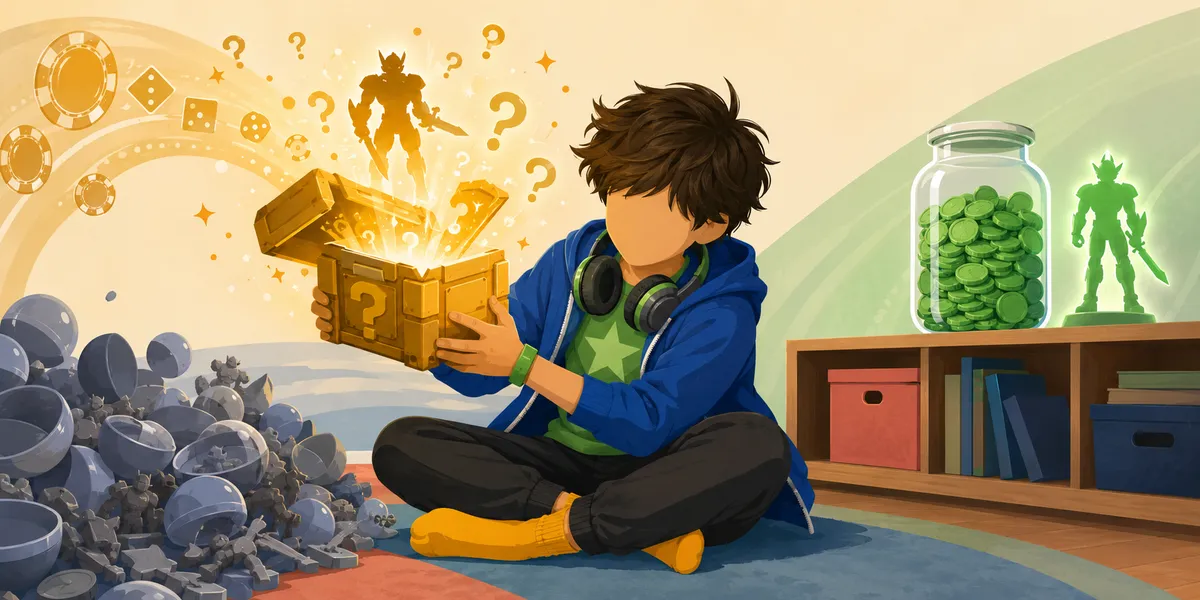
Pay real money, often through in-game currency, to open a crate with a random reward. Most pulls give something common; the item your kid wants is rare. The crate is the bet, and a well-made game keeps the rewards cosmetic.
Gacha
The same random pull, built into the whole game. Named after Japanese capsule-toy machines. Many gacha games are designed so the rare character or weapon is the point, the odds are steep, and limited-time 'banners' add a countdown to the randomness.
Skin gambling
The riskiest version, and the one that leaves the game. Teens take in-game items (skins) that have real resale value and bet them on third-party websites. Because skins convert to money, this is real-stakes gambling, and for a minor it is underage gambling.
Loot boxes versus gacha versus skin gambling
The three mechanics share a random core, but the money risk climbs steeply as you move across them, and knowing which one your kid is actually dealing with tells you how hard to lean in.
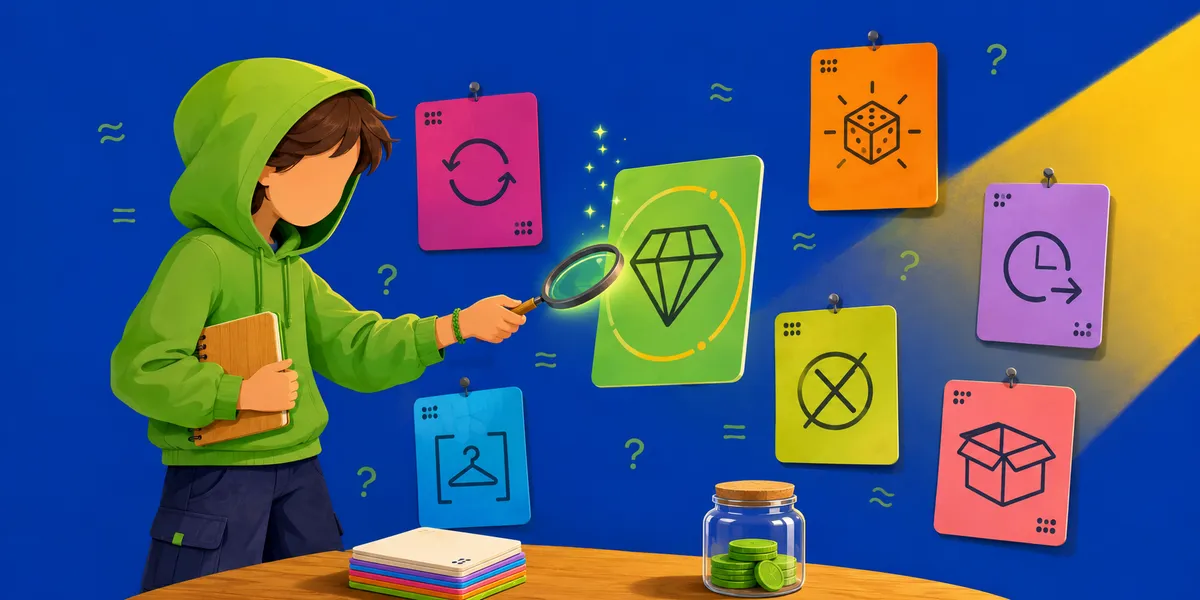
A loot box is the mildest version. Your kid plays a game, earns or buys a crate, and opens it for a random cosmetic. It is one of the seven shapes of in-game spending worth knowing by name. In a well-designed game the rewards are purely cosmetic, the odds are published, and a kid can play happily forever without opening one. The pull is real, but the floor is low.
Gacha is the same pull turned into the whole point of the game. The name comes from Japanese capsule-toy machines, and gacha games are usually built so the rare character or weapon is the reward the entire experience pushes you toward. The odds are often steep, and the most aggressive design choice is the limited-time "banner," a featured pull that adds a countdown timer to the randomness. A random reward plus a deadline is a combination borrowed straight from the casino floor.
Skin gambling is the one that should get your full attention, because it leaves the game entirely. Some in-game skins carry real resale value, and a set of third-party websites lets players bet those skins on roulette, coin flips, and match outcomes. Because the items convert to money, this is real-stakes gambling, and when a teenager does it, it is underage gambling. These sites are not run by the game studio, and their age checks are usually a single unticked box.
The research backs up the worry without overstating it. A survey of more than 7,000 players, published in PLOS ONE, found that the more people spent on loot boxes, the more severe their problem-gambling symptoms tended to be, and that the link was stronger for loot boxes than for ordinary in-game purchases. The authors are careful, and so should we be: the study shows a link, not proof that one causes the other. It is possible that kids already drawn to gambling simply spend more on loot boxes, rather than the loot boxes creating the problem.
A paid loot box is a slot machine that pays out in pixels. Regulators are still arguing about whether that counts. Your kid's brain already treated it like one.
Governments cannot agree either. Belgium's gaming regulator decided in 2018 that paid loot boxes break its gambling law, though in practice enforcement has been thin. The United Kingdom studied the question in 2022 and chose not to extend its Gambling Act, concluding only that "purchases of loot boxes should be unavailable to all children and young people unless and until they are enabled by a parent or guardian." Most countries, the United States included, lean on a label rather than a law. That patchwork is exactly why this lands on your plate instead of a regulator's.
The math the pull screen hides
Here is where the "are loot boxes gambling" question gets concrete, because the thing that makes a pull risky is not the price of one crate. It is the math of how many crates your kid actually needs.
When a game advertises a 1% drop rate, a kid hears "pretty likely." What 1% actually means is that each pull has a 1-in-100 chance, so on average you need about 100 pulls to land the item once. Not 100 guaranteed. On average. Because every pull is independent, a long string of misses does not make the next one any more likely, even though it feels like it has to. That gap, between how close it feels and how the odds really work, is the gambler's fallacy, and it is doing a lot of quiet work on the pull screen.
The simulator below makes the gap visible. Set the odds and the price, then open crates and watch the real-money counter climb. Run it a few times with your kid. The point lands fastest when the same 1% odds cost a few dollars on a lucky run and several hundred on an unlucky one.
★ Interactive · the cost of a maybe
Loot box pull simulator
Advertised odds (example)
Real money per pull
Pulls
0
Real money spent
$0
What 1% actually means
- Typical wait most common outcome
- 100 pulls$200
- Half of players need at least this many
- 69 pulls$138
- 1 in 10 players spend this much or more
- 230 pulls$460
- 1 in 100 unlucky worst-case streak
- 459 pulls$918
Each pull is independent. A near-miss does not make the next one more likely.
Some games soften the worst case with a "pity timer," a guarantee that the rare item drops by a set number of pulls. Pity is genuinely better for players, and the simulator lets you switch it on to see the effect. But notice what it does and does not do. It caps how unlucky you can get, while still charging real money for every pull up to that cap. A guaranteed rare at pull 90 is still a guaranteed bill.
Why kids are especially wired for this
None of this is a knock on your kid's self-control, and it helps to say that out loud, because the design is built by professionals to work on grown adults too. A few things make it land harder on a developing brain.
The reward schedule is the big one. A prize that arrives on a random, occasional basis is the most habit-forming pattern in behavioral psychology, the same one that keeps a slot-machine player in the chair. Game designers know this, and the better-funded studios tune the timing with care. The US Federal Trade Commission fined Epic Games 245 million dollars in 2022 for using manipulative "dark pattern" designs on players, many of them children, which tells you these choices are deliberate rather than accidental.
Then there is the money itself, hidden one step back. Your kid is almost never spending dollars. They are spending gems, or coins, or a currency they bought in an odd-numbered bundle weeks ago, so the real cost never quite registers. The American Academy of Pediatrics has warned for years that children have a harder time than adults recognizing when they are being sold to, and a virtual currency is a sales tool wearing a disguise.
Add the social layer, which is where skins do their real work. A rare skin is not just a picture; it is status the kid wears in front of their friends. And add the sunk-cost feeling, the "I have already spent thirty dollars, I cannot stop now" logic that even adults fall for. Stack those together and "just one more pull" stops being a weakness and starts being a predictable result.
A parent's playbook for loot boxes and skin gambling
You do not have to ban the game, and in most cases you should not, because a flat ban teaches nothing and just moves the spending to a friend's house. The goal is to make the random pull a deliberate choice instead of a reflex. Four moves do most of the work.
Lock down one-tap buying. In your console or app-store family settings, turn off saved payment for the kid's account and require a password or your approval for every purchase. This single step removes the "tap while you are not looking" problem that most surprise charges come from.
Put chance-based spending on a fixed budget. Decide on a set monthly amount that can go toward anything random, and let your kid manage it. When it is gone, it is gone until next month. A cap they control out-teaches a hundred case-by-case noes, and it is the same principle behind the Roblox spending playbook.
Use a 24-hour wait on anything "limited." The countdown timer on a banner pull exists to stop your kid from thinking. A one-day wait is the cheapest counter there is. Most limited-time offers come back, and the ones that do not were rarely worth it.
Turn the pull into a goal. This is the move that changes the math. Instead of betting twenty dollars on a 1% chance at a skin, ask what your kid could buy outright for the same money, and save toward that instead. Sprout Saver is built for exactly this swap: money goes into a named Goal inside the Vault, a 24-hour cooldown sits in front of impulse withdrawals, and the progress bar gives the brain the same small hit of anticipation a pull does, pointed at something the kid will actually keep.
For the teen years, add one more conversation: skin gambling sites are off limits, and here is the reason. Be specific that betting skins for real value on an outside website is gambling for money, that it is illegal at their age, and that those sites are designed to take more than they give. Teens respect the straight version of this far more than a vague "be careful online."
A few lessons in the app rehearse these exact decisions without any real money on the line. They are worth doing together.
The first puts the kid inside an in-game store and lets them practice spotting the pressure. The second is built around the countdown-timer trick that banner pulls lean on. The third helps an older kid notice their own spending triggers before their thumb finds the buy button. None of them lectures; all of them rehearse the decision.
If you want the wider picture, the financial literacy guide covers how all of this fits into raising a money-smart kid, and the microtransactions explainer above is the companion piece on the non-random kinds of in-game spending.