In this guide
The tooth fairy leaves $5.84 per tooth on average in 2026, according to the Delta Dental 2026 Original Tooth Fairy Poll, up 17% from $5.01 in 2025. A first tooth averages $7.17. Those are the headline numbers many parents are searching for. The rest of this post is the harder question: how much should your tooth fairy leave, and what should the kid do with it once they have it?
The tooth fairy is rarely just a tooth fairy. For a lot of kids, the coin or bill under the pillow is the first money they hold that is unambiguously theirs. The amount matters less than the ritual you build around it.
Tooth fairy: how much per tooth in 2026?
The 2026 going rate is $5.84 per tooth, the national average in Delta Dental's poll of 1,000 parents, and a first tooth averages $7.17. You do not have to match it. A smaller amount you can repeat for every tooth, and every sibling, does the job just as well as the average does.
Here is the published 2026 picture from Delta Dental's annual survey, in one place:
- National average per tooth: $5.84.
- First-tooth average: $7.17, about 23% above the average tooth.
- Year-over-year change: up 17% from $5.01 in 2025, the first rise since 2023.
- Highest regional average: Northeast at $6.45.
- Lowest regional average: Midwest at $5.27.
- Gifts instead of cash: 32% of children got a physical gift this year, up from 19% in 2025.
2026 national average
Delta Dental Tooth Fairy Poll
First-tooth bump
About 23% above a regular tooth
The 2025-to-2026 jump matters, but it is not a one-way escalator: it ended a two-year decline. Over the long run the rate has climbed a lot; when the poll started in 1998, the average was $1.30 a tooth. At $5.84, a household paying $1 or $2 per tooth is now visibly below the national average. That is not a problem by itself. Plenty of families pay $1 a tooth on purpose and hold it for every tooth. But it is useful to know where your number lands.
The interactive picker further down on this page lets you set a household budget tier, region, and first-vs-regular tooth, and shows your suggested amount against the Delta Dental data on a thermometer. It is a starting point, not a prescription. You know your household better than a poll does.
How much should the first tooth be worth?
As much as you like, as long as you choose it on purpose. In the 2026 poll the first tooth averaged $7.17, about 23% more than the $5.84 average, and 38% of parents said the tooth fairy leaves extra for it. A bump is common but not the rule; a flat amount for every tooth is just as normal.
The first-tooth average rose from $6.24 in 2025 to $7.17 in 2026. If you do want a bump, two patterns hold up well: $10 for the first tooth and $5 for the rest, or $5 for the first and $2 for the rest. The exact number is less important than picking it before the tooth is lost.
The reason to bump the first tooth on purpose is straightforward. The first tooth is a one-time event. The kid will remember the amount for years and tell the story to a younger sibling, a cousin, or eventually their own kid. The other 19 baby teeth come over the next several years; they teach a different lesson (consistency) and benefit from a different cadence (steady, predictable, lower).
The first tooth is a one-time event, and the kid will remember the amount for years. If you bump it, bump it on purpose.
A second reason: the first tooth is your one chance to set the precedent for everything that follows. Once you have left $10 for the first tooth, $2 for the second tooth reads as a downgrade unless you said so up front. Picking a single amount that you can hold for every tooth after the first is the move. Set the first-tooth number a little higher; hold every later tooth at the lower number; and resist mid-cycle inflation.
★ Interactive · 30 seconds
How much should the tooth fairy leave?
The picker rounds to the nearest quarter because tooth-fairy realism matters. Few parents leave $4.86. The output is meant to be a starting amount you adjust to what is in your wallet at 11 p.m. on tooth night.
How much does the tooth fairy pay in each region?
In the 2026 Delta Dental poll the Northeast paid the most, $6.45 per tooth, followed by the West at $5.99, the South at $5.89 and the Midwest at $5.27. The order moves: the Midwest's average jumped 52% from 2025 and the Northeast's 41%, while the South slipped from first place.
The gap from the highest region to the lowest is $1.18 a tooth, which adds up to about $24 across 20 baby teeth. A few caveats matter. The poll asked 1,000 parents nationwide, and each region is only a slice of that sample, so the regional figures are rougher than the national one. A household in the Midwest that pays $5 per tooth is not "below average for the Midwest" in any meaningful sense; the regional average is just where the survey landed this year. Treat it as context, not a benchmark to hit.
Tight budget
$1 to $2 per tooth. Predictable, sustainable, and the amount does not define the moment.
Comfortable
$3 to $6 per tooth. Up to about the Delta Dental national average of $5.84.
Generous
$7 to $10+ per tooth. Often paired with a first-tooth bump or a small gift. Set the precedent on the first tooth; the rest follow.
The right calibration for your household is the one you can hold for every kid, every tooth, for years. A generous first-tooth amount you cannot repeat for the second kid creates a fairness problem you do not need. A tight amount you hold consistently teaches that the tooth fairy is reliable, which is the actual lesson at this age.
What should my kid do with tooth fairy money?
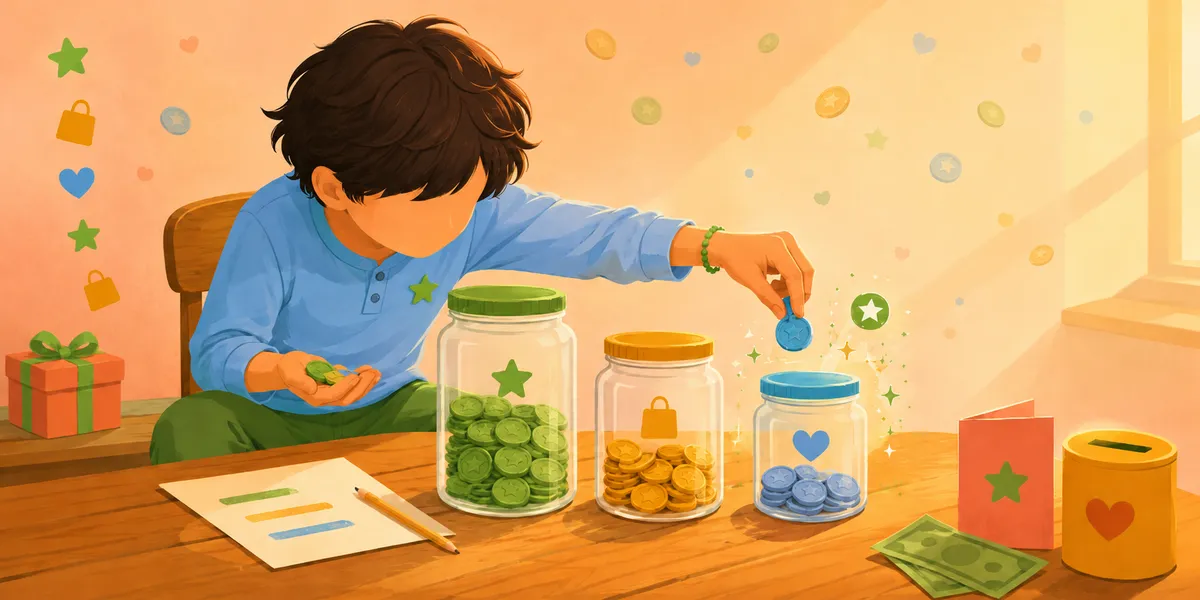
Let them hold it for a day, then sort it together. Three jars or envelopes labeled Save, Spend and Give turn the first money a kid owns into their first budget. At six, most of it may go to Spend, and that is fine; the ritual of choosing matters more than the ratio.
The Delta Dental figure is interesting trivia. What happens to the cash the next morning is where the money lesson lives.
Many six-year-olds have no system for holding money yet. The tooth fairy is often the first cash event, which means it is also the first chance to build the system. The CFPB's Money as You Grow guide starts exactly here, for kids as young as 3 to 5: "Find a jar or can, and label it for saving." Three lessons inside the app teach the kid side of this same arc. Pair them with whatever you actually leave under the pillow.
A practical pattern for this age: when the kid finds the money, do not rush to sort it. Let them hold it for a day. Then sit down with three jars (or three envelopes, or the in-app Save / Spend / Give bucket system) and ask the kid where they want each piece to go. At six, they will probably put most of it in Spend. That is fine. The point is the ritual, not the ratio. Across the next 19 teeth, the Save jar can start winning more of the share. For the deeper rundown on the jar system across all ages, the Save / Spend / Give system post walks through the splits that work as kids get older.
The ritual is what parents in the poll value, too. In Delta Dental's August 2026 follow-up, 47% of parents said a tooth fairy visit helps keep family traditions going and 39% said it creates a memorable bonding moment with their child.
What if my kid asks where the money comes from?
Keep the first answer short and warm, because a young kid is usually asking out of curiosity. When the question has a real doubt behind it, like "is it really you?", tell the truth and invite them onto the team: now they get to help the tooth fairy for a younger sibling, and keep the secret.
Two phases to this question.
Phase one: the curious question. The kid asks out of curiosity, not skepticism. The answer is short and warm: "The tooth fairy comes when kids lose teeth and leaves a little money. Different families have different traditions about how much." Notice what this answer avoids. It does not invent elaborate lore. It does not promise an ever-larger amount. It does not name a specific other family. Calm and brief is the register.
Phase two: the real question. The kid asks with an actual question behind it. "Is it really you?" "Did Sam's mom tell him it was her?" When this version of the question arrives, the answer is the truth. The move that lands is to frame the reveal as joining the team. "Yes, it is us. Now you get to be the tooth fairy for [younger sibling], and you cannot tell them. Welcome to the club."
A small note on the older-sibling-tells-the-secret problem. If a sibling spoils the secret to a younger one, do not punish or lecture. Have the older one help leave the next tooth's money. The reveal turns into participation. The teaching-6-year-old post covers the broader question of how much honesty to share with kids at this age; the same principle applies here.