In this guide
★ Key takeaways
- Chores for 6-year-olds work best when they're short, visible, and unpaid. The earning conversation comes a year or two later.
- Five core chores stick at six: bedroom tidy, table set, hamper drop, pet bowl, sock sort. Everything else is a stretch.
- Photo proof and a chart help. Cash for completion does not, yet.
- Skip the dishwasher, the vacuum, and anything sharp. Save them for eight.
If you've ever stood in your kitchen wondering which chores are actually fair to ask your six-year-old to do, you're in good company. Chores for 6-year-olds is one of the most-googled parenting questions in this age band, and most of the answers you'll find are Pinterest-perfect lists of thirty tasks that quietly assume your kid is already eight. This post is a warmer, more honest take on what actually works at six: the five chores that almost always land, the three that look age-appropriate but mostly don't yet, the developmental signals that decide which is which, and the question of whether to pay, which we'll answer plainly when we get there.
What chores can a 6 year old actually do
There are really only about five chores that work reliably for most six-year-olds. We say "about five" because the exact mix depends a little on your kid, but in our experience these are the ones that almost always land:
- Drop dirty clothes in the hamper. It's a clean two-step instruction ("pick this up, put it in there"), it happens every day, and there's nothing to mess up.
- Tidy their bedroom. This one asks for a bit more: about five minutes of focus, and the ability to notice that "messy" and "clean" are different states. A nightly routine works best.
- Refill the pet water bowl. A favourite at this age, because it's a job with a creature attached. Just give it a quiet adult check, since six-year-olds often refill it half-full and call it done.
- Set the table with help. Needs the reach (or a stable step) and a steady hand on a glass, but if those are there, this becomes a daily contribution kids feel real pride about.
- Sort matching socks after laundry. A satisfying weekly task with a clear "I'm finished" moment, which is gold at six.
What actually sticks at six
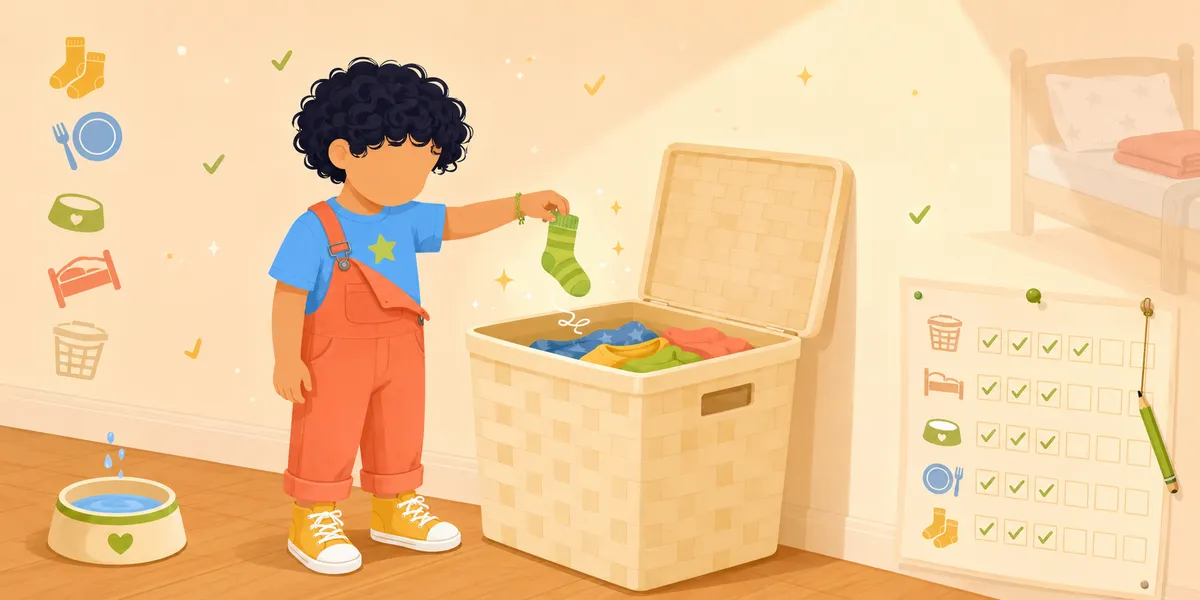
Bedroom tidy. Table set. Hamper. Pet bowl. Sock sort.
Payment at six
Family contribution, not income. Allowance handles the money.
There are also a few chores that look age-appropriate on a Pinterest list but mostly aren't, yet. Emptying the dishwasher sounds easy until you watch a six-year-old wrangle a stack of porcelain plates. Vacuuming a room defeats most kids at this age because of the cord, the attachments, and the sheer weight of the machine. And wiping down the bathroom sink runs straight into the chemical-spray question, which is reason enough to wait a couple of years. These aren't off-limits forever, just not yet. Most kids grow into them around eight, when the steady hand catches up to the willingness.
★ Interactive · 60 seconds
Which chores fit your six-year-old?
The widget above is essentially this whole post compressed into one interaction. Tick which of eight developmental signals your six-year-old has already cleared, and the "Ready this week" card shows the chores those signals unlock, while the "Stretch" card shows the ones that are close, just a capability or two away. We built the signal list from Money As You Grow and the CFPB Building Blocks model rather than a generic age chart, because the truth is the same calendar year contains six-year-olds who can carry a glass across the kitchen and six-year-olds who can't, and a real chore list should reflect that.
Age appropriate chores for 6 year olds, by capability not list
Here's the part we wish more parenting blogs would lead with: a list of chores by age is a starting point, not really an answer. The real answer is which capabilities your kid actually has today, because two six-year-olds in the same kindergarten class can be in pretty different places developmentally.
Three signals decide most of what a six-year-old can run with:
- Two-step instructions. Can your kid follow something like "pick this up, then put it in the bin"? If they can, the hamper drop, the toy pickup, and the sock sort will all click. If they're not quite there yet, that's totally fine; it's the skill the next month or two is for, and it tends to arrive on its own.
- About five minutes of sustained focus. Can they stay on one task for five-ish minutes without you needing to redirect them? If yes, bedroom tidy starts working as a routine. If not, you'll have better luck breaking tasks into one-minute chunks with a quick parent reset in between.
- Reach. Can your kid reach the table top without a stool? If yes, table-setting and pet-bowl refills open right up. If not, those can wait for the next growth spurt, or you can keep a sturdy step-stool nearby as the workaround.
A child who's cleared all three is genuinely ready for the full five-chore baseline above. A child who's cleared one or two is ready for a smaller subset, and that's a completely reasonable place to start. The honest version of "what can a six-year-old do?" isn't a list at all. It's "your six-year-old can do this if that is true," and you're the one who knows which "thats" are already in place. Money As You Grow's milestone guidance for six- and seven-year-olds is structured exactly this way, which is part of why we trust it.
It's also why the same generic chore chart for "kindergarteners," pinned in fifty different kitchens, works at fifty different rates. The chart is a template. Your kid's capabilities are what actually decide how it goes.
Should you pay a 6 year old for chores
This is the question we get asked more than any other in this age band, and we totally understand why. Your friends pay their kids, your parents either did or didn't, and the parenting internet is split in a way that makes you feel like you're choosing a tribe. So here's our honest take, with the reasoning attached so you can decide whether it fits your family.
Our short answer is: not yet, at least not for these baseline chores. At six, the chores themselves are doing the teaching, and adding money into the mix tends to muddy what they're actually learning. A hybrid system, where some chores are paid and some are family contributions, works beautifully a year or two from now, around seven or eight. Our companion post on whether kids should get paid for chores makes the case for hybrid at older ages, and we agree with it; this post is the missing chapter for the year before that switch makes sense.
Three reasons we land here for six-year-olds specifically.
Family contribution
The chore is what we do because we live here. No money attached.
Earning
Coming around seven or eight. One or two paid above-baseline tasks, on top of allowance.
Allowance
The weekly money. Independent of chores at this age.
First, the chores at this age are doing a particular kind of teaching that money can crowd out. Setting the table or putting socks in a hamper isn't really a job in the labor-exchange sense. It's a tiny rehearsal of "I live here, and these are the ways I help." Adding a dollar (or a quarter, or a sticker that converts to a quarter) shifts the meaning from "this is what we do as a family" to "this is what I get paid for," and it's surprisingly hard to shift it back later.
Second, and related: payment now creates an unlearning problem in a year or two. Imagine a six-year-old who's been getting a quarter every time she puts a sock in the hamper. At seven, you decide hamper duty is just part of being in the family, no more quarters. From her side of the kitchen, that doesn't feel like a values shift. It feels like a pay cut. You can absolutely get through that conversation, but it's a conversation you don't have to have if you never started paying for the baseline in the first place.
Third, there's actually a cleaner way to teach money at this age, and it doesn't go through chores at all. A weekly allowance (a small, predictable amount that arrives on the same day every week, completely independent of whether any specific chore got done) teaches the planning side of money beautifully: when does it arrive, what's it for, what gets saved. Our Save, Spend, Give system for kids walks through how this works at six. Think of it this way: chores teach effort, and allowance plus jars teach allocation. At this age, they're best as parallel tracks, not cause and effect.
The transition into a hybrid system fits naturally around seven or eight, when the daily-chore habit is steady and your kid can hold a one-week timeline in their head. The move is gentle: one or two above-baseline tasks (washing the car, raking leaves, a deep tidy of a shared space) start carrying a small dollar amount, layered on top of the unpaid baseline. The baseline itself stays unpaid. That part really is the rule, and the older-ages post explains why.
How a chore chart works at six
A chore chart at this age is really a visual tool, not a financial one, and that distinction matters more than it sounds. The best charts for six-year-olds are stickers, photos, magnets with the kid's name on them, anything they can physically move from "to do" to "done" with their own hands. The reward signal is the satisfaction of moving the marker, not the cash that's waiting behind it.
If you're building (or rebuilding) a chart for your six-year-old, four things tend to make the difference between one that sticks and one that gets ignored after a week:
- Keep the row count small. Three to five rows, max. Beyond that, the chart itself starts to feel like a chore.
- Use pictures or single-word labels, not full sentences. A six-year-old shouldn't have to read a paragraph to understand what they're doing.
- Put it where they can reach it. The chart they can manage themselves is the chart they'll actually engage with.
- Reset on a known schedule (every night, or every Sunday, or whatever rhythm fits your family) so the chart never silently piles up into a "you owe me" log.
We'd gently steer you away from putting cash directly on this chart at six. The money conversation works better on its own track, with a small weekly allowance that arrives independently of whether any specific chore got done. The chart tracks effort; the allowance tracks weeks. We see families collapse the two together all the time and it's far and away the most common reason a chore system stalls between ages six and eight.
When a chart starts to drift (and most do at some point), the fix is almost always structural, not motivational. Move the chart down to your kid's eye level. Cut a row. Rewrite "tidy bedroom" as "put three things away in your bedroom" if the bigger version has gotten vague and avoidable. Six-year-olds rarely respond to "you need to try harder." They almost always respond to "okay, the chart looks different now. Want to see?"
Lessons that teach chores at six
If you'd like a little outside help on the chore-and-earning conversation, four of the lessons in our Sprout Saver catalog are pitched right at this age. Worth a small honest caveat first: none of them teach "why we do chores" head-on yet. The family-contribution framing is still mostly something parents end up modeling at home. What these lessons do is each pick up a different piece of the same loop, in a way a six-year-old can absorb in a few minutes.
And if you'd rather just move your existing paper chart into the app, the Chore Management feature handles all the bookkeeping for you. You assign a task, your kid marks it complete, and there's an optional photo step, which at six we really do mean as a celebratory thing, not a verifying one. The Approval Workflow is built for older kids and paid tasks; at six, you can leave it in its lightest configuration or just turn it off entirely. For broader context, our companion guide on chore ideas by age covers what comes next in the seven-to-nine band and beyond.